
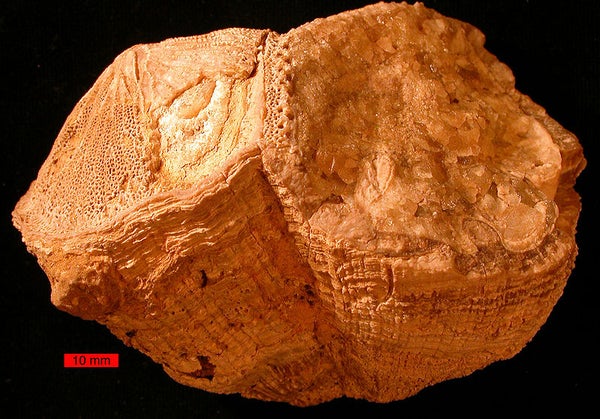

Open up a clam, and you might see the making of a tasty snack. You probably wouldn’t expect to find the history of our planet. But that’s what researchers have been deducing from a 70-million-year-old fossil clam. They opened up this mollusk’s secrets by drilling a small hole in its shell with a laser and analyzing the pattern of the growth.
“So we make a cross section through this shell. You see the growth layers in the shell a bit like the layers in a tree. And that allowed us to count the number of days in the year that far back in time.”
Niels de Winter, paleoclimatologist at the Free University of Brussels in Belgium. Using a laser to carefully count the number of growth rings in a 70-million-year-old fossil might seem like quite a laborious way to find out the number of days in a year. After all, we all know the answer is 365—and 366 in leap years—right?
On supporting science journalism
If you're enjoying this article, consider supporting our award-winning journalism by subscribing. By purchasing a subscription you are helping to ensure the future of impactful stories about the discoveries and ideas shaping our world today.
“That’s interesting, because what we found is that there were actually not 365 days in the year; there were a few more.”
You see, Earth’s spin on its axis gradually slows down over time. The reduction is due to the friction from Earth’s tides, which are driven by the moon’s orbit.
Back to that ancient clam. By measuring the rings on this mollusk’s shell, the team was able to put a precise number on the history of this process. Seventy million years ago, the faster rotation of the Earth meant that there were just 23 and a half hours in a day. [Niels J. de Winter et al., Subdaily-scale chemical variability in a Torreites sanchezi rudist shell: Implications for rudist paleobiology and the Cretaceous day-night cycle, in Paleoceanography and Paleoclimatology]
And measuring more shells might reveal more information about our planet’s past.
“It would also be very interesting to apply this on other shells—maybe also of the same time but also of different times so that we can map much better how this evolution took place.”
Scientists already use fossilized shells to reveal details of the Earth’s ancient climate. And now de Winter is hoping that he can read this preserved weather record in extra fine detail. This work could teach us about the climate of the distant past and maybe even help scientists better understand the climate change happening today.
“We might actually be able to extract things at a very, very high resolution about climate that far back in time. The prospect of being able to get the information at this scale is very exciting for a climate scientist like myself.”
—Adam Levy
[The above text is a transcript of this podcast.]
