
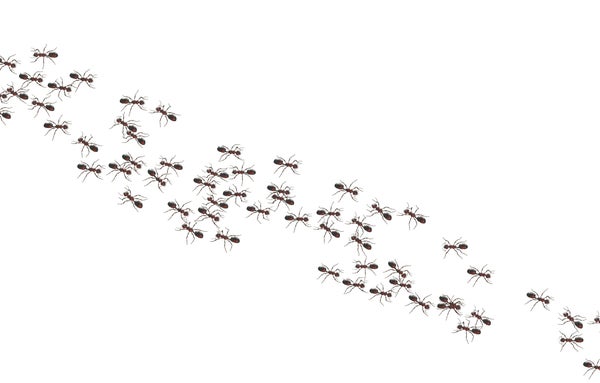

Anyone who commutes by car knows that traffic jams are an inevitable part of life. But humans are not alone in facing potential backups. Ants also commute—between their nest and sources of food. The survival of their colonies depends on doing this efficiently.
“The more there are, the more food they’re going to bring back. But at the same time, they might end up with traffic jam because there are too many of them.”
Arizona State University mathematician Sebastien Motsch. When humans commute, there’s a point at which cars become dense enough to slow down the flow of traffic, causing gridlock. Motsch and his colleagues wanted to know if ants on the move could also get clogged. So they manipulated traffic density by constructing bridges of various widths between a colony of Argentine ants and a source of food. Then they waited and watched.
On supporting science journalism
If you're enjoying this article, consider supporting our award-winning journalism by subscribing. By purchasing a subscription you are helping to ensure the future of impactful stories about the discoveries and ideas shaping our world today.
“The goal was to try to find out at what point they are going to have a traffic jam. But it appears that that never happened. They never, at one point, just stopped. They always managed to avoid traffic jam.”
The flow of ants did increase initially as ants started to fill the bridge and then leveled off at high densities. But it never slowed down, even when the bridge was nearly saturated with ants. The researchers then took a closer look at how the behavior of individual ants impacted traffic as a whole. That meant meticulously tracking thousands of separate ants as they made their way across the bridge.
Motsch and his team found that when ants sense overcrowding, they adjust their speeds and avoid entering high-density areas, which prevents congestion. These behaviors may be facilitated by pheromones, chemicals that tell other ants where a trail is. The ants also manage to avoid colliding with each other at high densities, which could really slow them down.
The study is in the journal eLife.[Laure-Anne Poissonnier et al., Experimental investigation of ant traffic under crowded conditions]
Can ants help us solve our own traffic problems? Not likely, says Motsch. That’s because when it comes to getting from point A to point B as fast as possible, human drivers put their own goals first. Individual ants have to be more cooperative in order to feed the colony. But the research could be useful in optimizing traffic flow for self-driving cars, which can be designed to be less like selfish humans—and more like ants.
—Susanne Bard
[The above text is a transcript of this podcast.]
