

Have you ever done something for someone else—knowing that your actions would solely benefit them and not you? Maybe you opened a door or donated blood or volunteered in a hospital’s ER during the pandemic.
This is called a prosocial behavior. Caregiving, group coordination, conflict resolution, sharing—humans engage in these types of behaviors all the time. We’ve learned that it’s a large part of the reason we’ve succeeded as a species.
But a major question remains in science: Are we the only species who do this?
On supporting science journalism
If you're enjoying this article, consider supporting our award-winning journalism by subscribing. By purchasing a subscription you are helping to ensure the future of impactful stories about the discoveries and ideas shaping our world today.
[CLIP: Chimpanzee sounds]
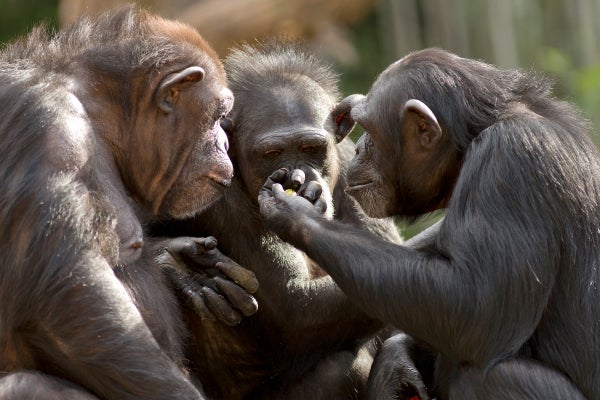
As one of our closest relatives, chimpanzees have long been studied for signs of this. Their genetic similarities could help us tease out the evolutionary trajectory of the desire to selflessly help others.
So far, research has provided mixed results on the question. Studies of these animals in the wild and captivity seem to come to different conclusions.
Some studies show that chimps cooperatively hunt, share food and console each other.
But one highly-cited study came to a very different conclusion: it said, “Chimpanzees are indifferent to the welfare of others.” The study used what’s called a “prosocial choice test”—a controlled lab experiment where chimpanzees in enclosures were given two options: push a button to give food to themselves or push the button to give food to themselves and a partner chimp. If they chose the latter, it was seen as a prosocial behavior.
In that study, chimps showed no special preferences for feeding themselves and a friend over feeding just themselves.
Enter new research and a remote juice fountain.
“We installed a button and a concrete fountain into the chimpanzees’ outer enclosures. The fountain was then hooked up to a large container of juice places outside the enclosure. When an individual pushes the button, it releases juice from the fountain. However, since the button and fountain are approximately five meters apart, the individual pushing cannot directly drink from the fountain. And if any other chimpanzees are at the fountain when the button is pushed, they, and not the pusher, will be able to drink the juice.”
That’s Sarah DeTroy of the Max Planck Institute for Evolutionary Anthropology, Leipzig.
Compared to previous controlled lab-based experiments, the setup for this was very naturalistic, and DeTroy says chimpanzees were able to interact with the fountain in their social groups. In this context, they discovered a willingness to act in the interest of others, with individual chimpanzees prepared to activate the fountain without benefitting themselves.
“We found that many of the chimpanzees were willing to prosocially provide valuable resources to the group members even if they couldn’t benefit themselves from their behavior. And this behavior also increased over time. We can’t, of course, know what the chimpanzees actual reasons and motivations for pushing the buttons were. But the fact that they were willing, over the course of two months, to repeatedly perform an action to which they had very little direct benefits is really fascinating and displays a high capacity for prosocial behavior.”
The degree of this prosocial behavior varied among three different groupings of chimps who were tested. They observed how groups who were more socially tolerant and felt comfortable around group members when in competitive situations were more likely to behave prosocially—particularly more toward group members for whom they have an existing bond, namely kinship.
“Our findings that chimpanzees can indeed behave prosocially and moreover show group deficiencies in their behavior suggest there is a lot we don’t yet know about their sociality. We might be more similar than we thought, and prosociality might have had a stronger role in shaping chimpanzees social behavior than previously assumed. We need more research to better understand the extent of chimpanzee prosociality, which will be able to inform us about the evolutionary past of our own unique human sociality.”
Further research may reveal what lies behind their prosocial motivations. But for now, it’s safe to assume that chimpanzees are not simply—and you’ll forgive the pun—aping human behavior.
Their research is featured in the journal Science Advances. [Edwin J. C. van Leeuwen et al., “Chimpanzees behave prosocially in a group-specific manner”]
—Mark Stratton
[The above text is a transcript of this podcast.]
