

Smallpox was eradicated worldwide in 1980. So generations of people have never had to experience the devastation the disease once brought.
“It could cause, sometimes, even in excess of 30 percent mortality. It caused these very painful blisters that covered the entire body.”
McMaster University’s Ana Duggan. She studies how genomes evolve.
On supporting science journalism
If you're enjoying this article, consider supporting our award-winning journalism by subscribing. By purchasing a subscription you are helping to ensure the future of impactful stories about the discoveries and ideas shaping our world today.
The first vaccine for smallpox was developed in 1796. It worked by infecting people with pus from pox lesions caused by similar but far less pernicious conditions, like cowpox. At the time, no one knew that viruses caused these diseases.
“We didn't have microscopes that were strong enough to see them. So we had physicians that were performing this procedure that they knew was beneficial. But they didn’t understand why it worked. They just knew that it worked.”
Smallpox vaccination became common in the 19th century. During the American Civil War, all new soldiers on both sides were required to be vaccinated.
“You had a large number of individuals who were congregated in a single place, such as an army barracks, where a disease can spread very easily.”
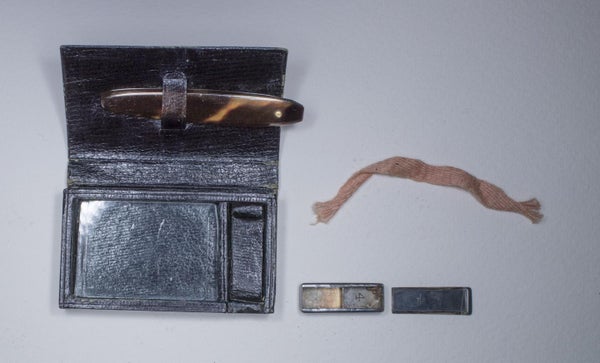
Back then, there were no mass-produced vaccines. Instead physicians often used fluids and pox scabs collected from previously vaccinated people and shared these materials with each other. They were kept in custom-made vaccination kits—a leather case containing a tin box, glass slides and a lancet for scratching the skin to introduce the vaccine into the body.
Some of these kits were later donated to the Mütter Museum of the College of Physicians of Philadelphia. Ana Duggan’s team recovered fragments of DNA from the kits, piecing together the viral genomes that were in those old vaccines.
“We were interested in understanding what virus was being used to protect against smallpox.”
The researchers discovered that the vaccines were all closely related strains of vaccinia, part of what’s called the orthopox group of viruses—which also includes both cowpox and smallpox. But the vaccinia virus is only distantly related to the variola virus that causes smallpox.
“However, it’s still a really effective vaccine. So we just had to have a virus that’s close enough that induces that immune response that is then protective against future infection. Vaccinia virus becomes the predominant strain of virus that’s used for smallpox vaccination in the 20th century.”
The study is in the journal Genome Biology. [Ana T. Duggan et al., The origins and genomic diversity of American Civil War Era smallpox vaccine strains]
As scientists scramble to develop vaccines for COVID-19, there are parallels to smallpox. For example, they’re looking into whether less virulent relatives of coronavirus could protect against COVID-19 the way vaccinia protects against smallpox.
“We've recently celebrated the 40th anniversary of the eradication of smallpox. And we are now in another global battle for eradication.”
—Susanne Bard
[The above text is a transcript of this podcast.]
