

[CLIP: Sounds of the Panamanian rain forest]
“So what you’re listening to now, that’s a recording from the rain forest.”
That’s Marc Holderied of the University of Bristol in the U.K. He specializes in bioacoustics: how animals produce sound and communicate with the sounds they make. In the recording you just listened to, Holderied removed the sounds we humans can hear and reduced the frequencies of the sounds we normally wouldn’t hear so that they’re audible to our ears.
On supporting science journalism
If you're enjoying this article, consider supporting our award-winning journalism by subscribing. By purchasing a subscription you are helping to ensure the future of impactful stories about the discoveries and ideas shaping our world today.
“A rain forest is a very noisy environment. There’s insect sounds, bird sounds; there’s leaves rustling. And all of this makes it harder for you to detect something you want to hear.”
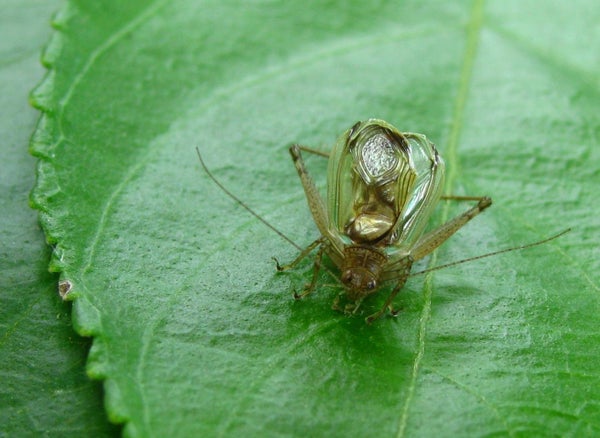
Holderied is particularly interested in sounds from the ultrasonic range—these are frequencies our ears can’t detect. But they come in loud and clear for a sword-tailed cricket in Panama. Here’s their home, slowed down so we can hear it.
[CLIP: Forest sounds]
Holderied and colleagues at the Universities of Bristol and Graz in Austria, recently discovered the sword-tailed cricket has a novel survival strategy when it comes to life in their noisy environment.
“Up there, it’s mainly other insects that produce noises that stop you from detecting what you really want to detect—and that is a predator that might attack you.”
Every night, hundreds of species of hungry bats fly around the rain forest and use echolocation to hunt for their meals, which can include the cricket.
“So we are talking neotropical rain forests, and they teem with different bat species. And most of them, or many of them, would be after insects. So the frequencies that they use to find the insect prey are covering pretty much a full echolocation-frequency range.”
Echolocation is great for hunting. But Holderied says it’s also a potential weakness for bats—because in the ultrasonic world, these calls are very, very loud.
“And once you have cracked that, once you have evolved an ear that lets you hear these calls, you can simply fly away and escape into safety....”
Which the cricket has learned to do.
“Basically, they have a response threshold–that’s what we call it. So they only respond to sounds that are very loud.”
And how do they respond? Well, they simply stop flying—and plummet toward the ground.
“Sometimes they don’t even drop all the way to the ground. So if the calls are louder, they stop flying for a longer period of time–that means a longer drop. But if they stop for just a half a second, that might not be enough time for them to hit the ground. And after this half a second, they start flying again, but they’re never actually crashing. But they drop out of the bat’s approach vector.”
The study of the crickets’ novel survival strategy is in the journal Philosophical Transactions of the Royal Society B. [Heiner Römer and Marc Holderied, Decision making in the face of a deadly predator: High-amplitude behavioural thresholds can be adaptive for rainforest crickets under high background noise levels]
“It’s a beautiful example of this predator-prey arms race.”
In this case, the passive prey has found a way to live, and listen for, another day.
—Emily Schwing
[The above text is a transcript of this podcast.]
