
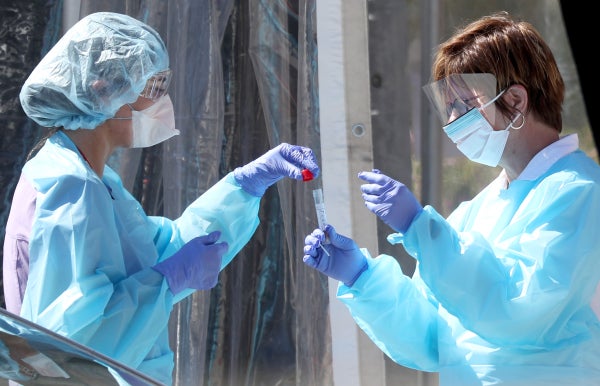

For this installment of our preelection podcast series I spoke to Scientific American’s senior medicine editor Josh Fischman.
So Josh, tell me about the issues in medicine and public health that are going to be affected by this election. Obviously, the first one is the coronavirus pandemic.
“Yeah, COVID is the big one. And it’s going to be affected by this election because we have the current Trump administration, which has a record that we can look at. And that record is of handling the coronavirus poorly—ignoring a lot of public health advice. And the results are sadly obvious to most of the country: we’ve got cases going up in 38 states. And the reasons for this are the administration’s ongoing refusal to develop a robust contact tracing force, to develop tests and a testing program that will enable public health authorities to quickly identify hotspots and isolate people. So step one would be to get the virus under control. And the Biden campaign actually has announced a plan to do that by increasing the number of contact tracers, by starting up a national testing board with the ability and the resources to ramp up testing. So at least we could get a handle on who’s infected, where infections are spreading rapidly. And we’ll be able to direct resources to isolating that, not letting it spread. So I think that that is the starkest and most important contrast.”
On supporting science journalism
If you're enjoying this article, consider supporting our award-winning journalism by subscribing. By purchasing a subscription you are helping to ensure the future of impactful stories about the discoveries and ideas shaping our world today.
And let’s talk just briefly about all the other public health and medical issues that are pretty much out of our consciousness right now because of the pandemic.
“You can look back at the last four years of budgets that the Trump administration has submitted and see that every year they have tried to slash the budgets for the National Institutes of Health, the National Science Foundation, the Centers for Disease Control. Now, every year Congress has countermanded those cuts and actually increased funding for the National Institutes of Health and the other agencies. But there’s a clear difference in what the Trump administration’s priorities are. They would like to bring these budgets down for reasons that they’ve never really articulated except to say that the federal government spends too much money. But it’s hard to see how spending too much money on health is really too much money.”
Yeah, because that’s not overhead as much as it is an investment.
“Exactly. You can see that when you look at health insurance. And when people have more complete health insurance, they are able to go to the doctor, they’re able to get prescription drugs, and they’re able to stave off serious illnesses that end up costing the U.S. taxpayer a lot more.”
—Steve Mirsky
[The above text is a transcript of this podcast.]
