
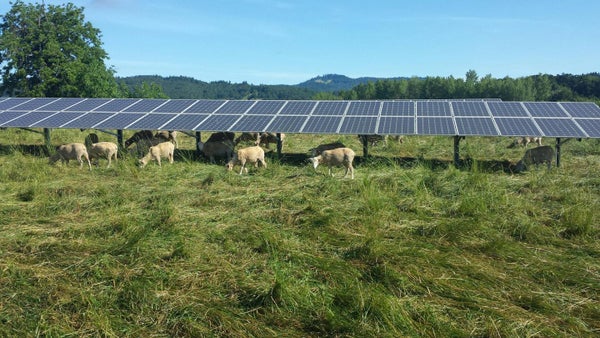

We often associate giant solar arrays with deserts. But the extreme heat can curb solar panels’ potential.
“It's like your laptop or your home computer. If it overheats, it slows down. So there's this tradeoff between having a lot, a lot of sun like in a desert, but if it gets too hot the efficiency of those panels drops.”
Oregon State University ecological engineer Chad Higgins.His team is interested in where photovoltaic panels should be located in order to maximize energy production. In addition to moderate temperatures and sunlight, they found that conditions for the most efficiency include low relative humidity and gentle winds that enhance transfer of heat from the panels. By analyzing satellite data for these four factors, they created a map of potential solar panel productivity for different land types around the globe. Coming out on top? Agricultural croplands.
On supporting science journalism
If you're enjoying this article, consider supporting our award-winning journalism by subscribing. By purchasing a subscription you are helping to ensure the future of impactful stories about the discoveries and ideas shaping our world today.
“And you think about it for a minute and it kind of makes sense. What is agriculture, but taking the sun's rays and converting it into a form of energy that we consume? So there's this sweet spot where you get a lot of sun but it's a temperate temperature and that is where you get the maximum productivity. And that’s also where plants thrive.”
Other factors also favor cropland solar.
“Agricultural lands tend to be closer to population centers where there is a market for electricity, rather than way off in the desert. Agricultural lands tend to be flat. They tend to be already disturbed. So you don't have as many ecological conservation worries.”
Higgins’ team thinks that agriculture and solar can complement each other, paving the way to a more sustainable energy future. The researchers estimate that installing photovoltaic panels on just one percent of croplands worldwide would be enough to meet all of humanity’s global electricity needs. The study is in the journal Scientific Reports. [Elnaz H. Adeh et al., Solar PV Power Potential is Greatest Over Croplands]
Higgins hopes the research will inspire collaborations between solar companies and farmers to feed the world and power it too. A prospect that should brighten anyone’s day.
—Susanne Bard
(The above text is a transcript of this podcast)
