
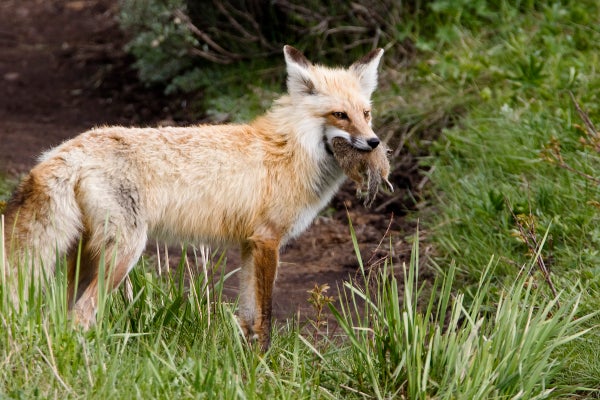

Foxes hunt small animals. And when other predators, including us, kill large animals, foxes are known to scavenge on the leftovers. Now a study of their scavenging shows that foxes have slyly relied on people for food for tens of thousands of years.
“I saw that foxes benefit a lot today from humans. And I was wondering if this was also the case in the past.”
Chris Baumann from the University of Tübingen’s Institute for Scientific Archaeology.
On supporting science journalism
If you're enjoying this article, consider supporting our award-winning journalism by subscribing. By purchasing a subscription you are helping to ensure the future of impactful stories about the discoveries and ideas shaping our world today.
Humans may have had a hand in driving the extinction of large herbivores like mammoths and mastodons in the Late Pleistocene, which ended around 12,000 years ago. But we inadvertently helped other species—and Baumann suspected that Pleistocene-era foxes may have been among them.
So Baumann and his team obtained the remains of 70 foxes found in southwestern Germany. They ranged from around 42,000 years ago, when Neandertals lived in the area, to some 30,000 years ago, when Homo sapiens came to dominate the region.
“In the study, we analyzed the bone collagen of the foxes and saw that there are indeed these different strategies of feeding.”
The carbon and nitrogen isotopes in the fox bones supplied clues to what the foxes had eaten. And at the earlier Neandertal-era sites, a few of the foxes hunted rodents, but most had a diet indistinguishable from the larger carnivores—meaning that they regularly scavenged from the kills made by wolves and bears.
But by the late Pleistocene, when we showed up, the foxes had switched to a diet of mainly reindeer and horse meat—that is, human table scraps. The finding is in the journal PLOS ONE. [Chris Baumann et al., Fox dietary ecology as a tracer of human impact on Pleistocene ecosystems]
“And so this one niche that we figured out, that comes when Homo sapiens entered this area, is more or less stable. So the foxes have time to feed on this resource over the last years of their life. And that’s very cool, because now we know that humans must have made some changes in the environment to provide this niche.”
Neandertals surely hunted animals, too. But there weren’t enough of them, or they didn’t stay in one place long enough, for the foxes to adapt to scavenging off their dinner plates. Homo sapiens, on the other hand, did stick around long enough to affect the foxes’ foraging strategy.
Baumann says that studying the remains of opportunistic scavengers like foxes—that learn to take advantage of human societies—can offer useful information about human impacts on ecosystems over time.
—Jason G. Goldman
[The above text is a transcript of this podcast.]
