

Ever hear of the pronghorn antelope in the American West? Well, it’s not really an antelope—it’s actually more closely related to giraffes than to true antelopes. And the last known migration of pronghorns occurs between Grand Teton National Park and the upper Green River Basin in western Wyoming. The so-called "path of the pronghorn" stretches more than 150 miles and is one of the longest mammal migration corridors that remain in North America.
That stretch is also the only federally designated wildlife migration corridor. The trouble is that the corridor intersects with roads and fences, presenting obvious problems to the animals.
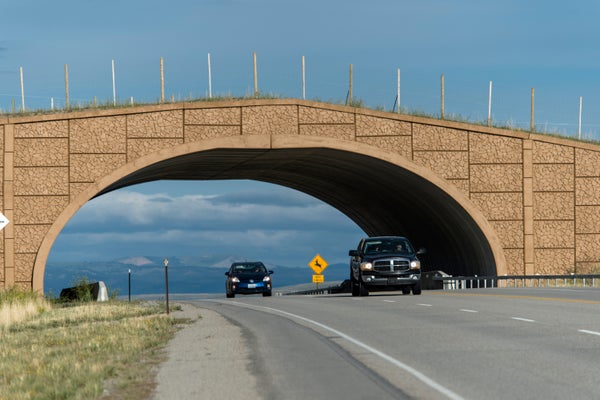
So Wyoming officials built eight wildlife crossings along some 12 miles of U.S. Highway 191: two overpasses and six underpasses. But having a crossing doesn't mean wildlife will use it. So researchers decided to assess the impacts of the $9.7-million investment.
On supporting science journalism
If you're enjoying this article, consider supporting our award-winning journalism by subscribing. By purchasing a subscription you are helping to ensure the future of impactful stories about the discoveries and ideas shaping our world today.
"We're out in the field, on spotting scopes, watching these animals as they're approaching brand-new structures. This was a perfect setting, because we had been studying these pronghorn, these animals on their long-distance migration, for about a decade."
Wildlife Conservation Society biologist Renee Seidler, now at the Idaho Department of Fish and Game.
She focused her observations on an area called Trapper's Point. Twice a year, between one [thousand] and two thousand pronghorn, along with some 3,000 mule deer pass through the area. Archaeological evidence indicates that pronghorn have been moving through Trapper's Point for at least 6,000 years. But now they have to contend with highways and fast cars. Before the wildlife crossings were built, the 12 miles of the two-lane Highway 191 saw an average of 85 animal–vehicle collisions each year.
"We looked at how many times an animal would attempt to use the crossing structure before they were able to successfully get to the other side. And the success rate of crossing within that definition increased over time."
In other words, the pronghorn eventually learned to use the crossing. And that's good news for motorists, too: Seidler found a 70 percent reduction in wildlife–vehicle collisions. The results are in the journal Global Ecology and Conservation.
Four years after the crossings were built, every single pronghorn successfully used them to avoid the highway and complete their migration.
"These are migrations that have been compared to migrations on the Serengeti in Africa. These are stellar, long-distance migrations, and I think as a culture we should hold innate pride in that…. Wyoming did a really good thing when they put in these crossing structures and fences, so that these animals can continue their migration."
—Jason G. Goldman
[The above text is a transcript of this podcast.]
