
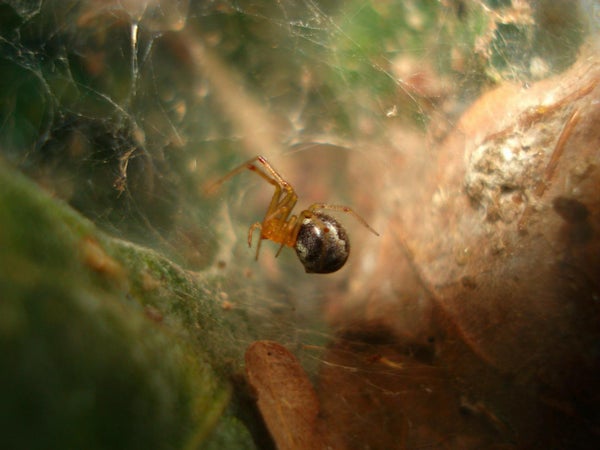

Some scientists stick to the lab. But others brave venomous snakes and downed power lines. Take Jonathan Pruitt, an evolutionary biologist at McMaster University. During last year’s hurricane season, he went to the U.S. Southeast to see how extreme weather affects—spiders.
“The goal of this experiment was basically to figure out how rare but extreme events might sculpt the traits of the animals that we see out there in the wild.”
The inherent difficulties in doing this kind of work has meant little research into how disasters can be a driving force behind natural selection.
On supporting science journalism
If you're enjoying this article, consider supporting our award-winning journalism by subscribing. By purchasing a subscription you are helping to ensure the future of impactful stories about the discoveries and ideas shaping our world today.
“The only way that I was able to do this was via the assistance of locals who, immediately following these storms, all get into their trucks and drive around to survey the damage of their houses. But they also bring chain saws. And so they will be cutting their way through state roads. And I basically just draft right behind what could be a conga line of F150s with chain saws and use them to cut a path back to my study sites.”
All that to survey the habits of tangle-web spiders, which live in colonies above bodies of water.
“And they cooperate into subduing prey together like a tiny, spidery pride of lions.”
The spiders come in two personality types: docile and aggressive. Aggressive colonies are prone to cannibalism, fight among themselves and are quick to pounce on their prey.Pruitt found that when aggressive colonies survived a storm, they produced more baby spiders than did their less aggressive counterparts. But in hurricane-free areas, docile colonies had more babies.
“So whether or not it’s good to be an aggressive society is contingent on whether or not you’re going to have a tropical cyclone strike you or not that year.”
Pruitt thinks the difference is due to hurricanes lowering the number of insect prey flying around. He says, of the aggressive spiders: “I think they are good at capitalizing on the limited number of time-sensitive foraging opportunities they have. So when a prey item hits their web, they run out fast, they grab it, it does not get away. And so, under those conditions, we think that’s why it pays to be aggressive.”
The research is in the journal Nature Ecology & Evolution. [Alexander G. Little et al., Population differences in aggression are shaped by tropical cyclone-induced selection]
Pruitt says as hurricanes become more common, they could have an outsized impact on the spider’s evolutionary trajectory.
“But the fact of the matter is we should not think that what we found in these spiders should be unique to them.”
Indeed, climate change could have a stormy future in store for all kinds of animal species.
—Susanne Bard
[The above text is a transcript of this podcast.]
