

Whether portrayed by Rex Harrison, Eddie Murphy or Robert Downey, Jr., Doctor Dolittle learned to talk to animals. But in reality, science has remained some distance from solving the long-standing question of how we humans learned to talk during our evolution.
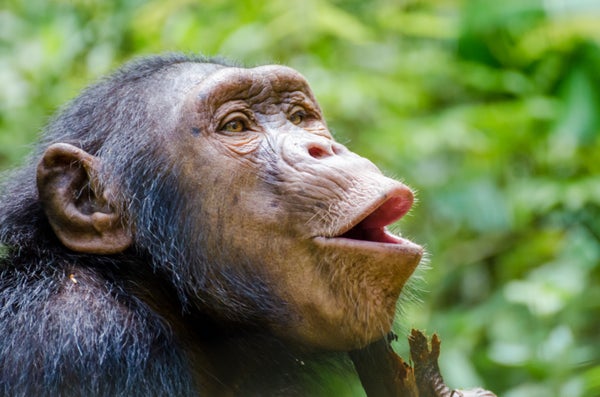
Here’s one new clue: a team of researchers in Great Britain have demonstrated how the rapid succession of opening- and closing-mouth rhythms by chimpanzees—known as “lip smacking”—mimics the natural pace of human mouths talking. The findings are in the journal Biology Letters. [André S. Pereira et al., Chimpanzee lip-smacks confirm primate continuity for speech-rhythm evolution]
This phenomenon has been observed before in other ape species who performed lip-smacking movements at around five hertz, which falls within a range of mouth opens and closes characteristic of all spoken languages, namely between two and seven hertz. But this lip-smacking timing connection had not been made in our closest evolutionary relatives—until now.
On supporting science journalism
If you're enjoying this article, consider supporting our award-winning journalism by subscribing. By purchasing a subscription you are helping to ensure the future of impactful stories about the discoveries and ideas shaping our world today.
“Mouth and vocal signals with speechlike rhythms had already been observed in some monkeys, gibbons and orangutans, one of our closest great ape relatives. So the last years had seen accumulating evidence that these rhythms—other than something that talking humans do—that this was a rhythm from deeper within our primate ancestry, recycled, so to speak, as a cornerstone for speech evolution.”
Adriano Lameira of the University of Warwick, who led the study.
“But the sense of evolutionary continuity toward speech still had a big gap to cross—the African apes. There was no evidence for speechlike rhythm, neither in gorillas, bonobos, nor chimpanzees.”
The study followed two captive populations of chimpanzees, one in the U.K. and one in Germany, as well as two wild populations in Uganda. Researchers observed lip smacking at an average of 4.15 hertz. They made all their observations whenever a chimpanzee was grooming another. Think of a hairdresser engaging in idle chatter with a customer at the beauty salon.
“The confirmation of speechlike rhythm of the mouth in chimpanzees does not reveal, per se, how language came about in our own lineage. But it offers the final confirmation to scientists that we are looking at the right place, that we are on the right track to solve this mystery and that great apes in captivity and the wild still have to reveal all their secrets about human nature and human origins.”
Lameira also notes that variation in lip-smack times both between and within the chimp groups do not appear to be hardwired. Rather the lip-smacking variability likely reflected how individual differences and environmental factors, and even social conventions, affect how chimpanzees communicate with each other. Even Doctor Dolittle might well be amazed.
—Mark Stratton
[The above text is a transcript of this podcast.]
