
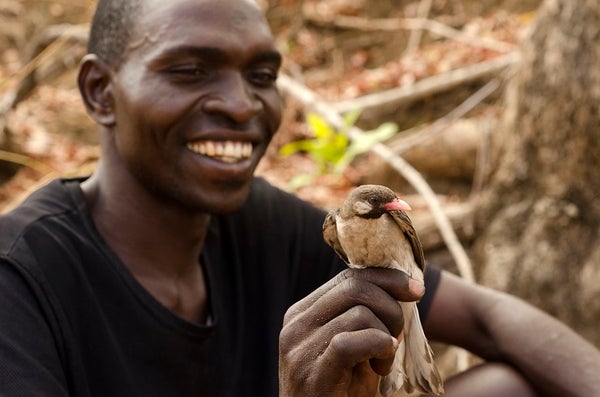

This is a story about the birds and the bees. When the Yao people of Mozambique want to find beehives full of honey they make this noise [brrrr-hm]. That sound attracts the attention of what are appropriately called honeyguide birds.
“If you ask Yao honey-hunters why they go brrrr-hm when they’re looking for a honeyguide, they’ll tell you, well, it’s the best way to attract a honeyguide and to maintain its attention while you’re following it to a bees’ nest.”
Claire Spottiswoode, of the University of Cambridge in England and the University of Cape Town in South Africa.
On supporting science journalism
If you're enjoying this article, consider supporting our award-winning journalism by subscribing. By purchasing a subscription you are helping to ensure the future of impactful stories about the discoveries and ideas shaping our world today.
The Yao have long known that they could attract honeyguides vocally, as part of a rare example of a mutualistic relationship between people and wild animals. The humans get honey and the birds then get what they want—the previously unattainable wax of the beehive, which they consider a delicacy. Spottiswoode’s study provides evidence that the humans are actually communicating with the birds.
“We wanted to specifically test whether honeyguides responded to the exact information content of the brrrr-hm call, which signals, if you wish, ‘I’m looking for bees’ nests,’ so we wanted to distinguish that from the alternative that the call simply alerts honeyguides to the presence of humans.”
Which the research team did—birds were much more likely to respond to brrrr-hm than to other sounds. The study is in the journal Science. [Claire N. Spottiswoode, Keith S. Begg and Colleen M. Begg, Reciprocal signaling in honeyguide-human mutualism]
Honeyguides may help people, but to other birds they can be monsters.
“Honeyguides are the real Jekyll and Hyde of the bird world…like cowbirds or cuckoos, honeyguides are brood parasites—they lay their eggs in other birds’ nests and exploit the care of other species to raise their young. And their chicks hatch with these very sharp hooks at the tips of their beak, which they use to stab the host young to death as soon as they hatch.”
You can watch some of this horror-movie-worthy footage that Spottiswoode captured several years ago by googling the phrase “honeyguide murder.”
As Africa becomes more urbanized, fewer people are engaging the birds to help them find honey. And the relationship between honeyguides and honey-hunters may be fraying.
“A young honeyguide hatches in the nest of another species knowing how to be a honeyguide. Because it doesn’t have the opportunity to learn from its own parents. But then if that’s not reinforced by experience, it’s lost.”
In the not-too-distant future then, honeyguides may still know where the beehives are—but they’ll be keeping that information to themselves.
—Sara Chodosh
[The above text is a transcript of this podcast.]
