New Issue: Orbital Catastrophe Ahead? Read Now

Hyena Society Stability Has Last Laugh

Female hyenas keep their clans in line by virtue of their complex social networks. Jason G. Goldman reports. 

Illustration of a Bohr atom model spinning around the words Science Quickly with various science and medicine related icons around the text

Join Our Community of Science Lovers!

Turns out that for hyenas, it's not what you know, but who you know

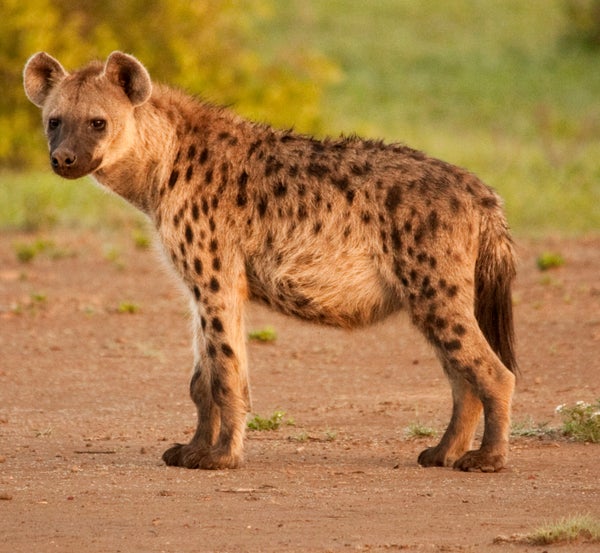
Spotted hyenas live in large, mixed-sex clans with fairly stable social hierarchies—and the females are in charge. 

"The matrilineal hierarchies that we see in spotted hyenas are also found in a lot of Old World monkeys."


On supporting science journalism

If you're enjoying this article, consider supporting our award-winning journalism by subscribing. By purchasing a subscription you are helping to ensure the future of impactful stories about the discoveries and ideas shaping our world today.


Michigan State University biologist Eli Strauss.

"It's been perplexing for a long time to a number of people what forces maintain this system, because it is somewhat unusual in the animal kingdom."

In some kinds of animal societies, your place in the dominance hierarchy can be explained by physical attributes like body size. But in other animals, dominance rank can be acquired through things like age or nepotism. 

Strauss and colleagues collected data about five generations of four groups of wild spotted hyenas in Kenya that they observed over a 27-year period. And the researchers saw multiple instances in which a smaller hyena came to dominate a larger one. They've even seen severely wounded hyenas become dominant to healthy ones. The results are in the journal Proceedings of the National Academy of Sciences. [Eli D. Strauss and Kay E. Holekamp, Social alliances improve rank and fitness in convention-based societies]

Given those examples, it would seem that rank in spotted hyenas is fairly arbitrary. But it turns out that what researchers call "rank reversals" happen only rarely in this species—just 14 percent of the time. So how does it stay so stable over time?

“They're systematically related to the coalitionary support that we observed…So females who had stronger coalitions with their top allies were more likely to increase their social rank.”

Spotted hyenas could only climb the social ladder if they were able to maintain a strong alliance. 

“The social bonds of these animals are really very fundamental in establishing the structure of their societies.”

In other words, the strength of relationships is what puts one hyena in its group’s spotlight.  

—Jason G. Goldman

(The above text is a transcript of this podcast) 

Jason G. Goldman is a science journalist based in Los Angeles. He has written about animal behavior, wildlife biology, conservation, and ecology for Scientific American, Los Angeles magazine, the Washington Post, the Guardian, the BBC, Conservation magazine, and elsewhere. He contributes to Scientific American's "60-Second Science" podcast, and is co-editor of Science Blogging: The Essential Guide (Yale University Press). He enjoys sharing his wildlife knowledge on television and on the radio, and often speaks to the public about wildlife and science communication.

More by Jason G. Goldman

Subscribe to Support Independent Journalism

Great science journalism requires human expertise, time, effort and creativity. And it costs money. That’s why I and the journalists here at Scientific American hope you’ll join our community.

When you subscribe, you are supporting staff and freelance journalists who are passionate about telling science stories that are true, important and compelling. Our editors and reporters are often experts in their fields, which means they understand the nuances of big discoveries and can untangle the breakthroughs from the hype. With a subscription, you are also supporting rigorous fact-checking to ensure the words we publish are precise and accurate. And you’re supporting original illustrations, graphics and photos that bring you closer to an advanced laboratory, an ice sheet in Antarctica or a space mission in orbit. You’re helping us craft other types of high-quality journalism as well: Our newsletters are carefully written, edited and curated by staffers you have or will come to know and love. Our Science Quickly podcast is based on original reporting, collaboration with editors and scientists and exacting production.

Subscriptions keep this engine running so we can continue to deliver thoughtful, rigorous and independent science journalism to you. In an era of viral misinformation, this work is crucial. If you value what we do, I hope you’ll consider joining us as a subscriber

Thank you,

Jeanna Bryner, Editor in Chief, Scientific American

Subscribe