

Babies are constantly surrounded by human language, always listening and processing. Eventually, they put sounds together to produce a “Daddy” or a “Mama.” But what is still elusive to neuroscientists is exactly how the brain works to put it all together.
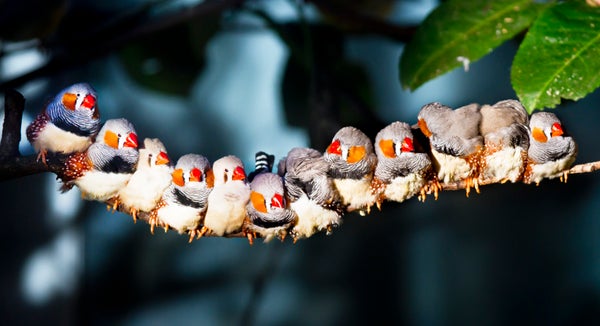
To begin to figure it out, a team of researchers turned to a frequent stand-in for human infants when it comes to language learning: the song-learning zebra finch.
“Well, we’ve known for about 70 years or so that songbirds learn their song by first forming a memory of their father’s song or another adult’s song. And then they use that memory in order to guide their song learning.”
On supporting science journalism
If you're enjoying this article, consider supporting our award-winning journalism by subscribing. By purchasing a subscription you are helping to ensure the future of impactful stories about the discoveries and ideas shaping our world today.
Neuroscientist Todd Roberts from the UT Southwestern Medical Center in Texas.
“It’s been a long-term goal of the field to try to figure out how or where in the brain this memory is. This form of learning, this type of imitative learning that birds do, is very similar to the type of learning that we engage in on a regular basis—particularly when we’re young, we use this type of learning to guide our speech learning.”
Roberts and his team had a hunch that the interface between sensory areas and motor areas in the brain was critical for this process, and they zeroed in on a group of brain cells called the NIf.
“In order to really prove that we were on the right track and that we could identify these circuits, we thought that maybe we could go in and see if we could implant a false memory.”
To do it, the researchers used a technique called optogenetics. First, they used a virus to cause the neurons in the birds’ NIf to become sensitive to light. Then, using a tiny electrode as a flashlight, they activated the neurons. The length of each pulse of light corresponded with the amount of time the neurons would fire. And the birds’ brains interpreted that time period as the length of each note.
Soon enough, the birds began to practice the notes they had learned, even though they never really heard the sounds in the first place. The songs that these birds began to sing wouldn’t win them any prizes. But amazingly, the birds produced them in the correct social situations. The researchers say this is the first time anybody has pinpointed a part of the brain necessary for generating the sorts of memories needed to mimic sounds. The study was in the journal Science. [Wenchan Zhao et al., Inception of memories that guide vocal learning in the songbird]
“This line of research is going to help us start to identify where in the brain we encode memories of pertinent social experiences that we use to guide learning. And we know that there are several neurodevelopmental disorders in people that have really profound effects on this type of learning.”
—Jason G. Goldman
[The above text is a transcript of this podcast.]
