
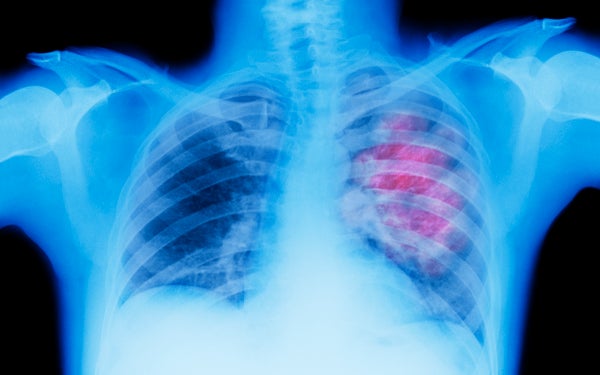

Imagine getting screened for early-stage lung cancer simply by taking a deep breath from an inhaler and then peeing into a cup.
Sangeeta Bhatia, a professor of health sciences and engineering at M.I.T., described how that might be possible in a TED talk she gave in 2016:
[CLIP: “What if you had a detector that was so small that it could circulate in your body, find the tumor all by itself and send a signal to the outside world? It sounds a little like science fiction. But actually, nanotechnology allows us to do just that.”]
On supporting science journalism
If you're enjoying this article, consider supporting our award-winning journalism by subscribing. By purchasing a subscription you are helping to ensure the future of impactful stories about the discoveries and ideas shaping our world today.
Bhatia’s idea was to invent nontoxic nanoprobes that doctors could put inside your blood or lungs or gut to detect tiny tumors when they’re easier to treat—before they grow big enough to spread throughout the body and damage vital organs.
[CLIP: “I dream that one day, instead of going into an expensive screening facility to get a colonoscopy or a mammogram or a pap smear, that you could get a shot, wait an hour and do a urine test on a paper strip.”]
In 2017 Bhatia’s team reported a proof-of-concept experiment in Nature Biomedical Engineering that demonstrated nanoprobes like this working to detect early-stage ovarian cancer in mice.
And now the group has refined this technology further to create a screening test for lung cancer that is more sensitive than the CT scans used today. The team of Harvard and M.I.T. researchers described their work in the April 1 issue of Science Translational Medicine. [Jesse D. Kirkpatrick et al., Urinary detection of lung cancer in mice via noninvasive pulmonary protease profiling]
Lung cancer accounts for nearly a quarter of all cancer deaths in the U.S. each year, in large part because most cases of lung cancer are not caught until after the disease has already spread to other sites.
Yet when lung cancer is caught and treated early, the majority of patients survive the disease for at least five years. But CT screening for lung cancer is not widely used around the world, because it’s expensive, and more than 90 percent of positive tests turn out to be benign growths, not cancer. So this kind of screening leads to a lot of unnecessary and invasive biopsies.
In Bhatia’s study, which was done on mice genetically engineered to develop lung tumors very similar to those seen in people, the nanoprobes were able to detect tumors about 50 times smaller than other screening methods. And it produced no false positives.
The nanoprobes are designed to release reporter molecules when they come near certain kinds of lung tumors. Once released, the reporters pass into the blood, get filtered out by the kidneys and then exit the body in the urine.
The group is now working to repackage the nanoprobes into a form that could be inhaled as a powder or through a nebulizer. If that succeeds, then the technology will have to proceed through several years of clinical trials before it could be used to screen people for lung cancer.
[CLIP: “And I hope that what this mean is that is that one day we can detect tumors in patients sooner than 10 years after they’ve started growing ... and that this would lead to earlier treatments and that we could save more lives than we can today with early detection.”]
—W. Wayt Gibbs
[The above text is a transcript of this podcast.]
