New Issue: Orbital Catastrophe Ahead? Read Now

Microplastics in Fresh Water Are Mostly Laundry Lint

Microplastic particles are everywhere, but in freshwater systems, 60 percent of particles are clothing lint from laundry.

Illustration of a Bohr atom model spinning around the words Science Quickly with various science and medicine related icons around the text

Join Our Community of Science Lovers!

Plastic waste breaks down into ever smaller pieces, becoming tiny enough to waft in the air and flow in the water. A study published in June found that a person, on average, inhales or swallows at least 74,000 microscopic particles of plastic each year. And there are multitudes of miniscule plastic beads and fibers in the environment.

So what’s the most common type of microplastic? Recent research finds that, in freshwater at least, it’s tiny pieces of artificial fibers—from laundry lint.

“We were interested in the microbeads, and we found them, but we found microfibers much more prominently. So 60 percent of the microplastics that we obtained were actually these microfibers.”


On supporting science journalism

If you're enjoying this article, consider supporting our award-winning journalism by subscribing. By purchasing a subscription you are helping to ensure the future of impactful stories about the discoveries and ideas shaping our world today.


Sherri Mason is a chemist specializing in plastic pollution in freshwater systems at Penn State Behrend.

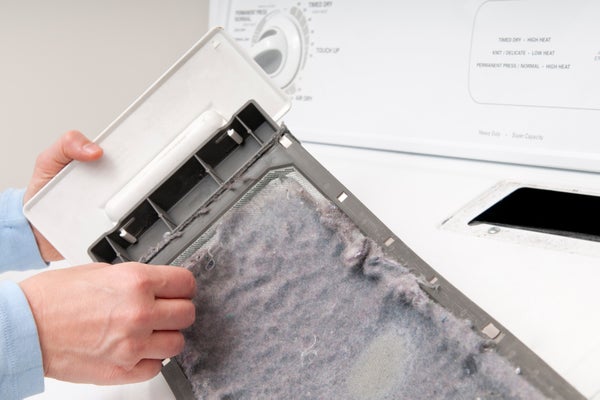
“I was surprised, although, like, you kind of go, ‘Oh, I really shouldn’t have been.’ Because we all clean out our lint filters on our dryers. We should be like, ‘Oh, of course if it’s coming off in the dryer, that whole process is starting in the washer.’”

Synthetic textiles shed nonbiodegradable fibers, which enter wastewater—and travel beyond. Mason’s report is in the publication American Scientist. [Sherri A. Mason, Plastics, plastics everywhere]

“There are microplastics in the air, and as you have, you know, precipitation events, it—they come raining down. Or as basically air comes into contact with water, these microplastics are going to end up in the water that way.” Even in the most isolated corners of the world.

Mason notes that natural materials also shed fibers in the wash, but microbes know how to digest them. Not so for microplastic fibers. They may take centuries to degrade, so they accumulate.

“And fibers, microfibers, are quickly becoming kind of the most prominent, and we find them everywhere. And I think now people are, like, ‘Okay, we really need to be looking at these fibers.’”

—Eilene Augenbraun

[The above text is a transcript of this podcast.]

Eliene Augenbraun is a multimedia science producer, formerly Nature Research's Multimedia Managing Editor and Scientific American's senior video producer. Before that, she founded and ran ScienCentral, an award-winning news service providing ABC and NBC with science news stories. She has a PhD in Biology.

More by Eliene Augenbraun

Subscribe to Support Independent Journalism

Great science journalism requires human expertise, time, effort and creativity. And it costs money. That’s why I and the journalists here at Scientific American hope you’ll join our community.

When you subscribe, you are supporting staff and freelance journalists who are passionate about telling science stories that are true, important and compelling. Our editors and reporters are often experts in their fields, which means they understand the nuances of big discoveries and can untangle the breakthroughs from the hype. With a subscription, you are also supporting rigorous fact-checking to ensure the words we publish are precise and accurate. And you’re supporting original illustrations, graphics and photos that bring you closer to an advanced laboratory, an ice sheet in Antarctica or a space mission in orbit. You’re helping us craft other types of high-quality journalism as well: Our newsletters are carefully written, edited and curated by staffers you have or will come to know and love. Our Science Quickly podcast is based on original reporting, collaboration with editors and scientists and exacting production.

Subscriptions keep this engine running so we can continue to deliver thoughtful, rigorous and independent science journalism to you. In an era of viral misinformation, this work is crucial. If you value what we do, I hope you’ll consider joining us as a subscriber

Thank you,

Jeanna Bryner, Editor in Chief, Scientific American

Subscribe