
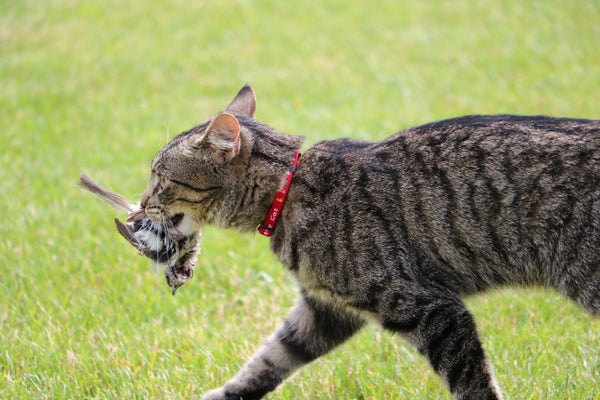

Domestic cats that live or go outside kill lots of wild animals. Recent studies find that outdoor cats in North America take out between 10 and 30 billion birds and mammals each year.
Still, it hasn’t been clear what kind of an impact the world’s 600 million pet cats have on wildlife populations—and whether that impact poses a threat to biodiversity conservation.
“Anyone who has a cat sees their cats bring animals home. And the question is, ‘Well, does it matter?’ And especially, we wanted to know, ‘Where are the cats actually hunting? Are they hunting in their backyards? Or are they going out into the nature preserves?’”
On supporting science journalism
If you're enjoying this article, consider supporting our award-winning journalism by subscribing. By purchasing a subscription you are helping to ensure the future of impactful stories about the discoveries and ideas shaping our world today.
North Carolina State University zoologist Roland Kays.
Together with colleagues in the U.K., Australia and New Zealand, Kays distributed small GPS trackers to citizen-scientist cat owners. They attached the trackers to their cats’ collars. In all, more than 900 pet cats were tracked this way, all of which were routinely allowed to roam freely outside.
Some cats were true explorers. One British cat called Max walked almost two kilometers back and forth along a road between two neighboring villages—twice! But the majority were homebodies, rarely straying more than 100 meters from home. In other words, they used their own backyards, plus those of a few neighbors, as their hunting grounds. The findings are in the journal Animal Conservation. [Roland Kays et al., The small home ranges and large local ecological impacts of pet cats]
A single pet cat doesn’t kill as many animals as a wild cat does to survive. But the pet’s impact happens in a much smaller area. So in a given area, say 100 square meters, pet cats kill between two and 10 times as many other animals as do similarly sized wild predators.
“We were able to put this into kind of a currency, into a value of ‘How many prey animals does a pet cat kill per hectare, sort of per area, per year?’ And that’s something we can also estimate for wild predators. So we were able to estimate this for a wild cat called the jungle cat, which is about the same size. And they kill a lot more per cat because they have to hunt to get everything that they eat, whereas the pet cats get their food bowl. But they hunt over a massive area, compared to the pet cats.”
And in some places, including California, Florida, Australia and elsewhere, cats were an important threat to some species that are already in trouble.
“On one hand, it’s kind of good news that the cats aren’t going out further abroad. But it’s bad news that they're quite likely to have an impact on animals they share space with near their houses.”
With so much killing concentrated around people's houses, the positive impacts of urban wildlife—like the beauty of songbirds or the way small lizards can control insect pests—could get washed away in precisely the areas where those benefits are most appreciated. So when conservationists implore cat owners to keep their pets indoors, scientific evidence agrees.
—Jason G. Goldman
[The above text is a transcript of this podcast.]
