
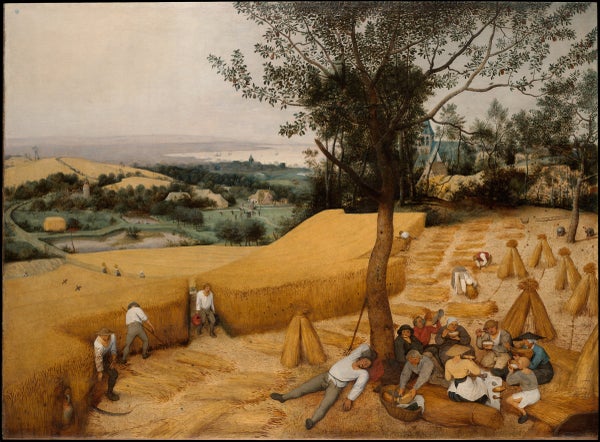

Pieter Bruegel’s iconic 1565 painting The Harvesters hangs at the Metropolitan Museum of Art in New York City. The work depicts peasants cutting stalks of wheat nearly as tall as they are.
“Nowadays, if you walk through a wheat field, you basically see that wheat is about knee-height. The short stature is essentially a consequence of breeding from the second half of the 20th century.”
University of Ghent biologist Ive De Smet.
On supporting science journalism
If you're enjoying this article, consider supporting our award-winning journalism by subscribing. By purchasing a subscription you are helping to ensure the future of impactful stories about the discoveries and ideas shaping our world today.
Selective breeding favoredgenes for reduced height, because they came along with genes for increasing yields to feed a growing population. De Smet says wheat is just one example of how historical artwork can allow us to track the transformation of food crops over time. He teamed up with art historian David Vergauwen of Amarant to catalogue such artwork around the world.
“We have been mainly looking at things where we kind of can spot changes in shape, in color, in size.”
Friends since childhood, their interest in plants in artwork began with a visit to the Hermitage Museum in St. Petersburg, Russia—where they noticed an odd-looking watermelon in an early-17th-century painting by Flemish artist Frans Snyders.
“So if you think of a watermelon, you cut it through, it should be dark red on the inside. But that one appeared to be pale and white.”
Biologist De Smet assumed the painter had done a poor job. But art historian Vergauwen had a different idea.
“He says, ‘No, this is one of the best painters ever from that era. So if he paints it like that, that’s the way it must have looked like.’”
Other paintings revealed that both red and white watermelons were cultivated during the 17th century. The color is determined by a gene that controls the pigment lycopene.
“There must have been some sort of mutation preventing the accumulation of that color. Now, with all the genetic knowledge that we have from various plant species, we can look in more detail how something comes about.”
For example, De Smet says carrots first started to be depicted as orange only in the 16th century, thanks to selective breeding for the beta-carotene pigment. And until the 18th century, European strawberries appear tiny in paintings—they then grew in size with the advent of crossbreeding with North American varieties.
The research is in the journal Trends in Plant Science. [David Vergauwen and Ive De Smet, Genomes on canvas: Artist’s perspective on evolution of plant-based foods]
Ultimately, the team hopes to create an online research database of historical plant artwork. They seek the contributions of art enthusiasts around the world via the social media hashtag #artgenetics. But, they caution, the source paintings need to be realistic.
“If you're going to use, for example, Picasso to try and understand how a pear looked in the early 20th century, you might be misled.”
Indeed, such an attempt could be fruitless.
—Susanne Bard
[The above text is a transcript of this podcast.]

.JPG)
