
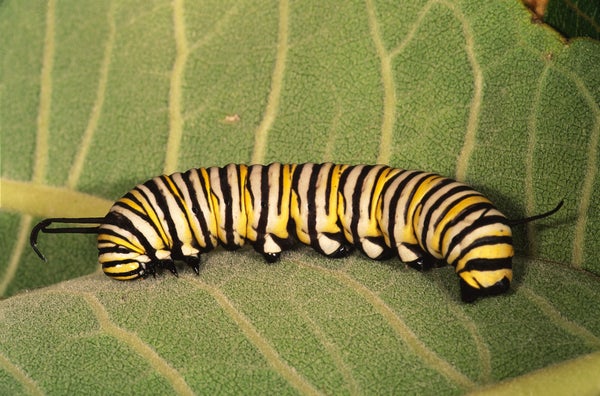

One of the delights of summer is to see monarch butterflies dancing through the air. But it’s becoming harder to see them in certain locales—in some places the population has dropped by as much as 90 percent. And climate change may make life even more challenging for these charismatic insects. That’s because higher carbon dioxide levels can lower the amount of toxins in milkweed—the monarch caterpillar’s food. The caterpillars use those toxins to protect themselves from a deadly parasite that produces spores.
“When the caterpillars are really small…those spores get into the monarch’s gut and they break apart and they start drilling holes in the gut lining and reproducing and just doing nasty parasite things that are bad for the monarchs.
Leslie Decker, an ecologist at Stanford University. Decker and her colleagues raised hundreds of monarchs. They fed half of the caterpillars milkweed grown at current CO2 levels. The other half got milkweed grown at nearly double those CO2 levels.
On supporting science journalism
If you're enjoying this article, consider supporting our award-winning journalism by subscribing. By purchasing a subscription you are helping to ensure the future of impactful stories about the discoveries and ideas shaping our world today.
“What we found is that elevated CO2 changes the medicinal quality of the milkweed in a way that makes monarchs sicker. They're less able to tolerate their pathogen, so the parasite becomes more hurtful…to them. And it also reduces their overall lifespan when they're infected in comparison to uninfected monarchs.”
The caterpillars that ate milkweed grown with more carbon dioxide grew into butterflies that died as much as a week earlier than the normal life span.
“As a human, you think, oh, well that's not that meaningful. But then as an insect, or as an insect that needs to reproduce within a week, it's pretty important.” The study is in the journal Ecology Letters. [Leslie E. Decker et al., Elevated atmospheric concentrations of carbon dioxide reduce monarch tolerance and increase parasite virulence by altering the medicinal properties of milkweeds]
Decker say these findings are not just about butterflies and milkweed.
“Many of our medicines come from plants…and so what this study is highlighting to us, or at least creating a red flag for, is the fact that the medicinal contents in those plants could be changing under elevated CO2. They could be going up or down, but it could mean that we lose the medicinal efficacy, the protective ability of that green pharmacy around us.
—Marissa Shieh
[The above text is a transcript of this podcast.]

