
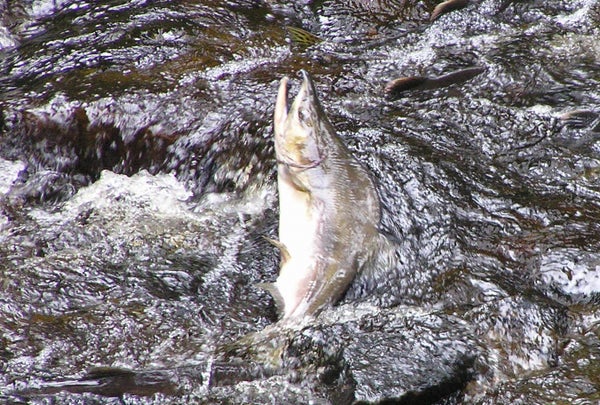

Sex. It drives people to do crazy things. Animals, too. They’ll make unsettling sounds, perform complex dances or show off giant plumes of colorful feathers. And, famously, salmon will swim hundreds of kilometers upstream to get down to business. They also inadvertently rework the landscape.
“Adult salmon spend most of their life out in the ocean and then they come in to freshwater to mate.” Washington State University ecologist Alex Fremier.
“What the female salmon will do is, she digs a hole in the streambed.”
On supporting science journalism
If you're enjoying this article, consider supporting our award-winning journalism by subscribing. By purchasing a subscription you are helping to ensure the future of impactful stories about the discoveries and ideas shaping our world today.
That little hole is called a redd. That’s where the salmon lays her eggs. And Fremier says when she builds it, she basically “unpacks” the stream bed, making all those loose sands and gravels more mobile. High water and flooding events move that sediment, which in turn exposes bedrock to further erosion.
“It’s quite impressive. We did not expect to have salmon, in some cases, changing the vertical position of a river channel up to 30 percent more than it would have without salmon in it.”
Fremier hypothesized that salmon not only influence landscape evolution, but that the evolution of salmon as a species itself has a landscape-level impact. To test the idea, he and colleagues recreated salmon redds in an experimental flume. Then they compared findings from the flume with real field observations. They cross-referenced all that data with discoveries from a study that modelled river profile erosion over five million years.
“We were stunned by the fact that it actually had a larger scale effect, given that we account for tectonic uplift, the big floods, like a lot of flood water moving downstream, different conditions of the gravel sizes on the river. I think we were all surprised by the fact that salmon could have such a large effect at that million-year scale.” The study is in the journal Geomorphology. [Alexander K. Fremier, Brian J. Yanites and Elowyn M. Yager, Sex that moves mountains: The influence of spawning fish on river profiles over geologic timescales]
So the next time you’re hip-deep in water angling for the big one, just remember: were it not for the risqué behavior of your future dinner, the terrain around you could look vastly different.
—Emily Schwing
[The above text is a transcript of this podcast.]
