New Issue: Orbital Catastrophe Ahead? Read Now

Science News Briefs from All Over

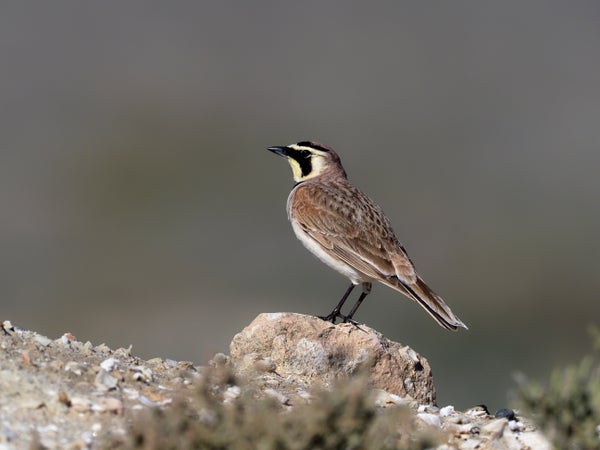
Here are some brief reports about science and technology from around the planet, including one about an incredibly well-preserved horned lark (Eremophila alpestris), like the one pictured, that lived 46,000 years ago.

Horned lark (Eremophila alpestris).

Illustration of a Bohr atom model spinning around the words Science Quickly with various science and medicine related icons around the text

Join Our Community of Science Lovers!

I’m assistant news editor Sarah Lewin Frasier. And here’s a short piece from the May 2020 issue of the magazine, in the section called Advances: Dispatches from the Frontiers of Science, Technology and Medicine.

The article is titled “Quick Hits,” and it’s a rundown of some non-coronavirus stories from around the globe.

From Chile:
Baffled by unexplained skin lesions on blue whales near Chile, scientists shot darts by crossbow to take samples from the whales’ blisters and fat in a bid to identify potential pollutant causes.


On supporting science journalism

If you're enjoying this article, consider supporting our award-winning journalism by subscribing. By purchasing a subscription you are helping to ensure the future of impactful stories about the discoveries and ideas shaping our world today.


From Russia:
A 46,000-year-old bird recovered from the Siberian permafrost is in such good condition that it looks like it died days ago, researchers say. It is the only nearly intact bird carcass found from the most recent ice age.

From Zimbabwe and Mozambique:
New research on African turquoise killifish, which live in ponds that dry up seasonally, reveals that their embryos can suspend development by up to two years, with no impact on their ultimate life span after hatching.

From China:
Researchers in northern China uncovered fossils of the oldest green algae on record, a multicellular two-millimeter organism that lived a billion years ago—the earliest known ancestor of today’s photosynthesizing plants.

From Malaysia:
Scientists say they are scaling up an experimental farm that uses metal-loving plants to draw and harvest nickel from the soil in the Malaysian portion of Borneo. The expanded farm will cover 50 acres.

From Austria:
For the first time, engineers executed a new bridge-building technique with two vertical girders, erecting them upward before unfurling the span like an umbrella. Two such structures will form bridges across Austrian rivers. The process saves time and cuts down massively on the scaffolding needed to build horizontally.

That was “Quick Hits.” I’m Sarah Lewin Frasier.

Sarah Lewin Frasier is a senior editor at Scientific American. She plans, assigns and edits the Advances section of the monthly magazine, as well as editing online news, and she launched Scientific American’s Games section in 2024. Before joining Scientific American in 2019, she chronicled humanity’s journey to the stars as associate editor at Space.com. (And even earlier, she was a print intern at Scientific American.) Frasier holds an A.B. in mathematics from Brown University and an M.A. in journalism from New York University’s Science, Health and Environmental Reporting Program. She enjoys musical theater and mathematical paper craft.

More by Sarah Lewin Frasier

Subscribe to Support Independent Journalism

Great science journalism requires human expertise, time, effort and creativity. And it costs money. That’s why I and the journalists here at Scientific American hope you’ll join our community.

When you subscribe, you are supporting staff and freelance journalists who are passionate about telling science stories that are true, important and compelling. Our editors and reporters are often experts in their fields, which means they understand the nuances of big discoveries and can untangle the breakthroughs from the hype. With a subscription, you are also supporting rigorous fact-checking to ensure the words we publish are precise and accurate. And you’re supporting original illustrations, graphics and photos that bring you closer to an advanced laboratory, an ice sheet in Antarctica or a space mission in orbit. You’re helping us craft other types of high-quality journalism as well: Our newsletters are carefully written, edited and curated by staffers you have or will come to know and love. Our Science Quickly podcast is based on original reporting, collaboration with editors and scientists and exacting production.

Subscriptions keep this engine running so we can continue to deliver thoughtful, rigorous and independent science journalism to you. In an era of viral misinformation, this work is crucial. If you value what we do, I hope you’ll consider joining us as a subscriber

Thank you,

Jeanna Bryner, Editor in Chief, Scientific American

Subscribe