Science News Briefs from around the Globe

A few brief reports about international science and technology from Indonesia to Spain, including one from Brazil about the highest-voltage electric eel ever discovered.

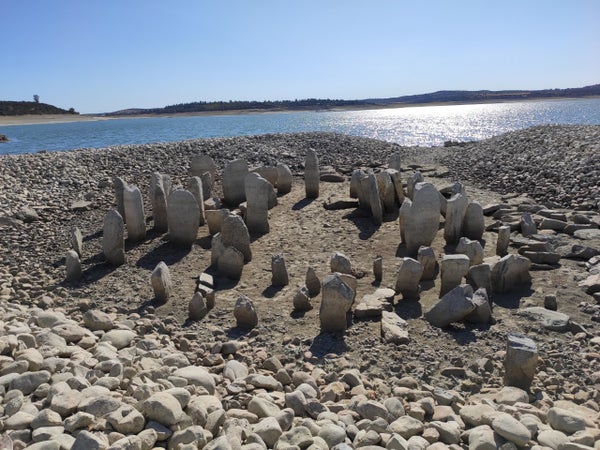
Dolmen of Guadalperal.

Illustration of a Bohr atom model spinning around the words Science Quickly with various science and medicine related icons around the text

Join Our Community of Science Lovers!

Hi, I’m Scientific American podcast editor Steve Mirsky. And here’s a short piece from the December 2019 issue of the magazine, in the section called Advances: Dispatches from the Frontiers of Science, Technology and Medicine. The article is titled “Quick Hits,” and it’s a rundown of some science and technology stories from around the globe, compiled by assistant news editor Sarah Lewin Frasier.

From Spain:
Summer’s powerful drought revealed a more than 4,000-year-old oval of at least 100 standing stones called the Dolmen of Guadalperal, which had been submerged since 1963 in an engineered reservoir.

From Russia:
Scientists identified a small group of Nordmann’s greenshanks, among the most endangered shorebirds, in a bog in Russia’s far eastern region. They helmed the first in-depth study of the bird since 1976 and are the first ever to capture a photograph of an adult on a nest.


On supporting science journalism

If you're enjoying this article, consider supporting our award-winning journalism by subscribing. By purchasing a subscription you are helping to ensure the future of impactful stories about the discoveries and ideas shaping our world today.


From New Zealand:
Researchers found that humpback whales traveling near Raoul Island, 700 miles off New Zealand’s coast, learn songs from members of other breeding grounds.

From Indonesia:
Climate models have more firmly connected a record-setting cold European summer in 1816 to the previous year’s eruption of Indonesia’s Mount Tambora, which injected sulfur dioxide into the atmosphere and caused widespread surface cooling.

And from Brazil:
A newfound species of electric eel in Brazil, Electrophorus voltai, produces the strongest shock scientists have ever measured from a living animal. It can produce 860 volts at up to one amp of current. 

That was “Quick Hits,” by Sarah Lewin Frasier.

Sarah Lewin Frasier is a senior editor at Scientific American. She plans, assigns and edits the Advances section of the monthly magazine, as well as editing online news, and she launched Scientific American’s Games section in 2024. Before joining Scientific American in 2019, she chronicled humanity’s journey to the stars as associate editor at Space.com. (And even earlier, she was a print intern at Scientific American.) Frasier holds an A.B. in mathematics from Brown University and an M.A. in journalism from New York University’s Science, Health and Environmental Reporting Program. She enjoys musical theater and mathematical paper craft.

More by Sarah Lewin Frasier

It’s Time to Stand Up for Science

If you enjoyed this article, I’d like to ask for your support. Scientific American has served as an advocate for science and industry for 180 years, and right now may be the most critical moment in that two-century history.

I’ve been a Scientific American subscriber since I was 12 years old, and it helped shape the way I look at the world. SciAm always educates and delights me, and inspires a sense of awe for our vast, beautiful universe. I hope it does that for you, too.

If you subscribe to Scientific American, you help ensure that our coverage is centered on meaningful research and discovery; that we have the resources to report on the decisions that threaten labs across the U.S.; and that we support both budding and working scientists at a time when the value of science itself too often goes unrecognized.

In return, you get essential news, captivating podcasts, brilliant infographics, can't-miss newsletters, must-watch videos, challenging games, and the science world's best writing and reporting. You can even gift someone a subscription.

There has never been a more important time for us to stand up and show why science matters. I hope you’ll support us in that mission.

Thank you,

David M. Ewalt, Editor in Chief, Scientific American

Subscribe