Science News Briefs from around the Planet

Here are some brief reports about science and technology from all over, including one about how a lizard population responded to hurricanes by developing larger and stickier toe pads on average.

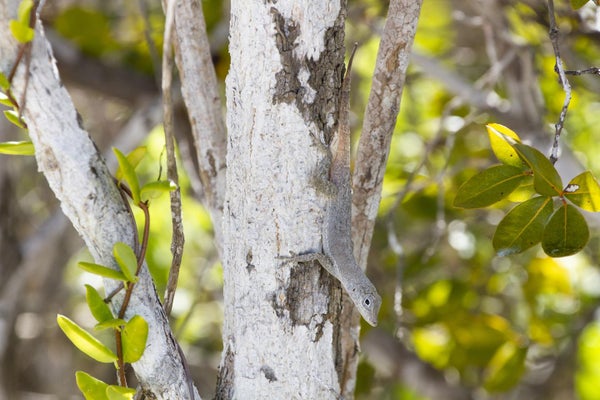
Turks and Caicos anole (Anolis scriptus).

Illustration of a Bohr atom model spinning around the words Science Quickly with various science and medicine related icons around the text

Join Our Community of Science Lovers!

Hi, I’m Scientific American assistant news editor Sarah Lewin Frasier. And here’s a short piece from the July 2020 issue of the magazine, in the section called Advances: Dispatches from the Frontiers of Science, Technology and Medicine.

The article is titled “Quick Hits,” and it’s a rundown of some noncoronavirus stories from around the globe.

From Turks and Caicos Islands:


On supporting science journalism

If you're enjoying this article, consider supporting our award-winning journalism by subscribing. By purchasing a subscription you are helping to ensure the future of impactful stories about the discoveries and ideas shaping our world today.


Analysis of anole lizards collected before and after Hurricanes Irma and Maria in 2017, and 18 months later, revealed that the surviving lizards and their descendants had larger and therefore “grippier” toe pads. The team examined lizard photographs from natural history collections and 70 years of hurricane data to confirm the trend.

From Italy:

Sediment samples drawn from the Tyrrhenian Sea revealed hotspots with up to 1.9 million microplastic particles per square meter—the highest concentration ever recorded on the seafloor. Most of this pollution comes from wastewater in sewage systems, researchers say.

From Antarctica:
Paleontologists found a fossilized 40-million-year-old frog on Seymour Island, near the tip of the Antarctic Peninsula. The frog is related to modern ones living in temperate, humid conditions in the Chilean Andes.

From Iraq:
Researchers probing the Turkish state archives found the earliest known record of a meteorite causing a death. The object struck a hilltop in neighboring Iraq in 1888, killing one man and paralyzing another.

From Japan:
Results gathered from the Kamioka Observatory, which includes an underground detector tank filled with 55,000 tons of water, suggest an intriguing discrepancy in how neutrinos and antineutrinos oscillate, potentially violating symmetry between matter and antimatter.

From Kenya:
Scientists identified a malaria-blocking microbe in mosquitoes on the shores of Lake Victoria. Every mosquito catalogued with this apparently benign fungus was free of the disease-carrying parasite, and experiments show the fungus prevented its transmission.

That was Quick Hits. I’m Sarah Lewin Frasier.

[The above text is a transcript of this podcast.]

Sarah Lewin Frasier is a senior editor at Scientific American. She plans, assigns and edits the Advances section of the monthly magazine, as well as editing online news, and she launched Scientific American’s Games section in 2024. Before joining Scientific American in 2019, she chronicled humanity’s journey to the stars as associate editor at Space.com. (And even earlier, she was a print intern at Scientific American.) Frasier holds an A.B. in mathematics from Brown University and an M.A. in journalism from New York University’s Science, Health and Environmental Reporting Program. She enjoys musical theater and mathematical paper craft.

More by Sarah Lewin Frasier

It’s Time to Stand Up for Science

If you enjoyed this article, I’d like to ask for your support. Scientific American has served as an advocate for science and industry for 180 years, and right now may be the most critical moment in that two-century history.

I’ve been a Scientific American subscriber since I was 12 years old, and it helped shape the way I look at the world. SciAm always educates and delights me, and inspires a sense of awe for our vast, beautiful universe. I hope it does that for you, too.

If you subscribe to Scientific American, you help ensure that our coverage is centered on meaningful research and discovery; that we have the resources to report on the decisions that threaten labs across the U.S.; and that we support both budding and working scientists at a time when the value of science itself too often goes unrecognized.

In return, you get essential news, captivating podcasts, brilliant infographics, can't-miss newsletters, must-watch videos, challenging games, and the science world's best writing and reporting. You can even gift someone a subscription.

There has never been a more important time for us to stand up and show why science matters. I hope you’ll support us in that mission.

Thank you,

David M. Ewalt, Editor in Chief, Scientific American

Subscribe