

Hi, I’m Scientific American podcast editor Steve Mirsky, and here’s a short piece from the June 2019 issue of the magazine, in the section called Advances: Dispatches from the Frontiers of Science, Technology and Medicine.
The article is titled "Quick Hits," and it’s a rundown of some science and technology stories from around the globe compiled by editorial contributor Jim Daley.
From Canada: Archaeologists have now confirmed that a Tyrannosaurus rex skeleton found in the 1990s at a fossil site in Saskatchewan is the biggest and heaviest on record. At nearly 42 feet long and almost 20,000 pounds, “Scotty” surpassed the record set by “Sue,” which was found in South Dakota in 1990.
On supporting science journalism
If you're enjoying this article, consider supporting our award-winning journalism by subscribing. By purchasing a subscription you are helping to ensure the future of impactful stories about the discoveries and ideas shaping our world today.
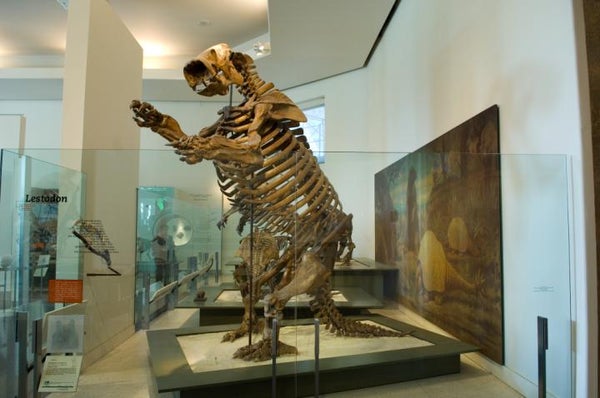
From Argentina: Archaeologists identified a site where ancient humans killed and butchered giant ground sloths (Megatherium americanum) in the Pampas region in eastern Argentina. The find provides evidence that humans contributed to the sloths’ extinction.
From Kenya: A science teacher who won the 2019 Global Teacher Prize announced he intends to donate the $1-million award to benefit society. Peter Tabichi, a Franciscan friar, mentors a science club that came in first in its category in the 2018 Kenya Science and Engineering Fair.
From the Comoros: Geochemists at Columbia University found a lode of quartzite, a metamorphic rock formed from sandstone, on the Indian Ocean island of Anjouan. The island is volcanic and had been thought to contain only igneous rocks.
And from North Korea: Physicists at Kim Il Sung University in Pyongyang have brokered a rare agreement to collaborate with Italy’s International School for Advanced Studies in Trieste. The North Koreans will study computational neuroscience with Italian physicists.
That was Quick Hits, by Jim Daley.
