New Issue: Orbital Catastrophe Ahead? Read Now

Science News Briefs from around the World

Here are some brief reports about science and technology from around the world, including one from Costa Rica about decoy sea turtle eggs with the potential to catch poachers.

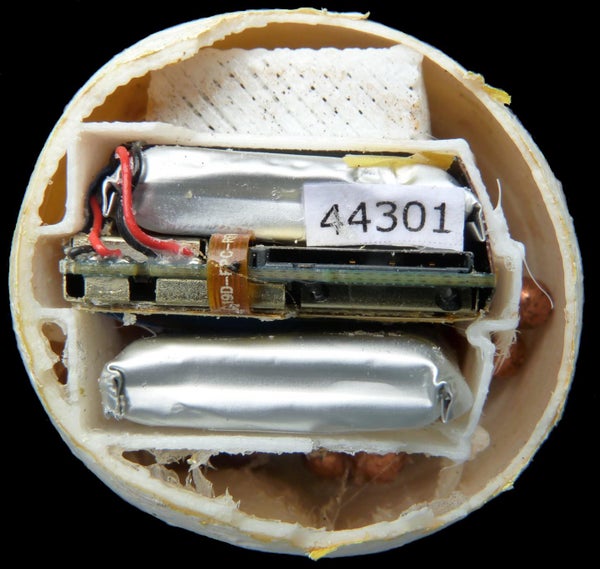
Interior of a decoy turtle egg with a GPS tracking mechanism.

Illustration of a Bohr atom model spinning around the words Science Quickly with various science and medicine related icons around the text

Join Our Community of Science Lovers!

I’m Scientific American assistant news editor Sarah Lewin Frasier. And here’s a short piece from the January 2021 issue of the magazine, in the section called Advances: Dispatches from the Frontiers of Science, Technology and Medicine.

The article is titled “Quick Hits,” and it’s a rundown of some noncoronavirus stories from around the globe.

From Costa Rica: Researchers embedded GPS devices in decoy sea turtle eggs to track poaching patterns. In their first field test, five of the 101 decoys (which had similar size, weight and texture to real eggs) traveled significantly, potentially reaching consumers.


On supporting science journalism

If you're enjoying this article, consider supporting our award-winning journalism by subscribing. By purchasing a subscription you are helping to ensure the future of impactful stories about the discoveries and ideas shaping our world today.


From Latvia: DNA harvested from a 700-year-old public toilet in Riga (as well as a 600-year-old cesspit in Jerusalem) will help researchers examine how human microbiomes have evolved over time. Microbial DNA from both sites matches some species common in modern hunter-gatherers and some in today’s city dwellers.

From Antarctica: New analysis suggests a 50-million-year-old foot bone found on Seymour Island comes from a species of bird whose wingspan reached 6.4 meters across. The researchers also attributed part of a large jawbone with toothlike structures to the species.

From Madagascar: In a Madagascar garden, researchers found several Voeltzkow’s chameleons—a rare species whose females can change from green to a vivid black, white and blue when excited. The short-lived species had not been documented for more than 100 years, and no females were previously recorded at all.

From Indonesia: New research shows that fluffy but venomous slow lorises frequently bite one another to settle territorial disputes—a rarity in venomous animals.

From Australia: An enormous, newfound coral reef off the continent’s northern coast is taller than the Empire State Building, rising more than 500 meters above the seafloor. Considered part of the Great Barrier Reef, it is the first detached reef structure discovered there in 120 years.

That was “Quick Hits.” I’m Sarah Lewin Frasier.

[The above text is a transcript of this podcast.]

Sarah Lewin Frasier is a senior editor at Scientific American. She plans, assigns and edits the Advances section of the monthly magazine, as well as editing online news, and she launched Scientific American’s Games section in 2024. Before joining Scientific American in 2019, she chronicled humanity’s journey to the stars as associate editor at Space.com. (And even earlier, she was a print intern at Scientific American.) Frasier holds an A.B. in mathematics from Brown University and an M.A. in journalism from New York University’s Science, Health and Environmental Reporting Program. She enjoys musical theater and mathematical paper craft.

More by Sarah Lewin Frasier

Subscribe to Support Independent Journalism

Great science journalism requires human expertise, time, effort and creativity. And it costs money. That’s why I and the journalists here at Scientific American hope you’ll join our community.

When you subscribe, you are supporting staff and freelance journalists who are passionate about telling science stories that are true, important and compelling. Our editors and reporters are often experts in their fields, which means they understand the nuances of big discoveries and can untangle the breakthroughs from the hype. With a subscription, you are also supporting rigorous fact-checking to ensure the words we publish are precise and accurate. And you’re supporting original illustrations, graphics and photos that bring you closer to an advanced laboratory, an ice sheet in Antarctica or a space mission in orbit. You’re helping us craft other types of high-quality journalism as well: Our newsletters are carefully written, edited and curated by staffers you have or will come to know and love. Our Science Quickly podcast is based on original reporting, collaboration with editors and scientists and exacting production.

Subscriptions keep this engine running so we can continue to deliver thoughtful, rigorous and independent science journalism to you. In an era of viral misinformation, this work is crucial. If you value what we do, I hope you’ll consider joining us as a subscriber

Thank you,

Jeanna Bryner, Editor in Chief, Scientific American

Subscribe