

Epidemiologists have long known that socially connected individuals like friends, family and co-workers are more likely to transmit pathogens to each other. But when an individual becomes obviously ill, their social connections become temporarily reduced: When we feel sick, we tend to stay away from others. And when we appear sick, others tend to stay away from us. That distancing usually helps to slow down the spread of a pathogen.
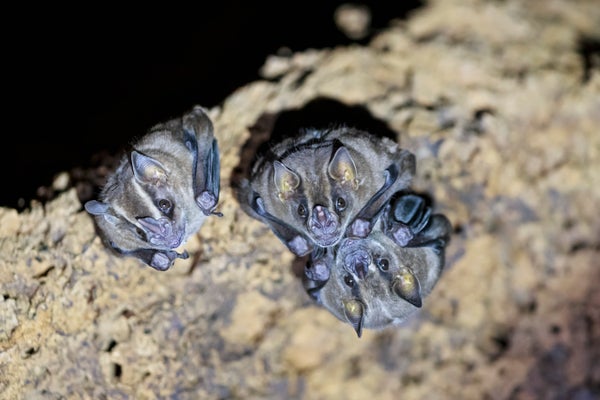
But not all social relationships work the same way. Parents of sick children will continue to care for those children at the risk of their own health. And that devotion is true beyond humans. Consider vampire bats. They usually groom their own offspring as well as other bats. And they share food. But illness changes some of those activities.
To track illness and behavior in a vampire bat community, researchers injected some bats with a substance that triggered their immune systems—the bats felt less well than usual without actually suffering from a disease.
On supporting science journalism
If you're enjoying this article, consider supporting our award-winning journalism by subscribing. By purchasing a subscription you are helping to ensure the future of impactful stories about the discoveries and ideas shaping our world today.
In this situation, unrelated bats stopped grooming each other. But mothers continued to care for their offspring, even if one of them seemed to be infected.
“In these changes in grooming, there was a difference between unrelated bats and maternal relationships. So what it looked like was that sick moms kept grooming their offspring, and healthy moms maintained grooming their sick offspring. Whereas we saw reductions between unrelated bats.”
Sebastian Stockmaier, a graduate student in integrative biology at the University of Texas at Austin, who led the study. Food sharing was different.
“So it looked like sick bats still received food from others, but they were groomed less by others. And so there are these infection-induced changes to social behaviors caused by these sickness behaviors, but they might vary, depending on what behavior you actually observe.”
So not only does the type of relationship matter, but the type of behavior does as well. It’s as if the bats set up this sick-time rule: I’ll feed you by regurgitating a blood meal into your mouth—but that’s it.
The study was in the Journal of Animal Ecology. [Sebastian Stockmaier et al., Sickness effects on social interactions depend on the type of behaviour and relationship]
The social relationships among vampire bats work a lot like human friendships. And when trying to understand the spread of infectious diseases through social networks, says Stockmaier, vampire bats teach us that the type of relationship and the type of interaction are important variables to consider.
—Jason G. Goldman
[The above text is a transcript of this podcast.]
