

“Those vicious, predatory dinosaurs that tended to be fairly small—six- to nine-, 10-feet-long, snout to tail—they’re certainly in the Jurassic Park movies, the things that terrorize people.”
Anthony Fiorillo, a paleontologist at Southern Methodist University in Dallas, Tex. For more than two decades now, Fiorillo has been digging up dinosaur fossils hundreds of miles north of the Arctic Circle in Alaska.
“So one of the fundamental questions about dinosaurs in Alaska, in the ancient Arctic, is: Did they live there all year round? Did they migrate? How did they get there?”
On supporting science journalism
If you're enjoying this article, consider supporting our award-winning journalism by subscribing. By purchasing a subscription you are helping to ensure the future of impactful stories about the discoveries and ideas shaping our world today.
A recent discovery sheds light on those questions.
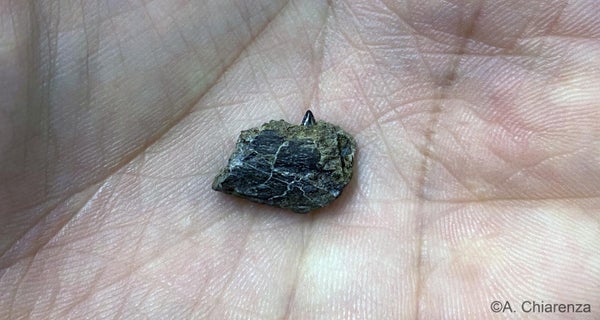
“This fossil that’s the subject of this story is a baby dinosaur. It’s a predatory dinosaur, and it is a baby; it’s not just a juvenile. And given the size estimate of this thing, this probably was not far from where the nesting ground was, so this is the first physical proof that at least some dinosaurs nested in the Arctic.”
Some of the first Arctic dinosaur remains ever found were discovered back in the 1960s in Svalbard, an archipelago north of mainland Norway. Since then researchers have theorized that dinosaurs must have migrated to avoid deeply cold winters. But Fiorillo says this new discovery disproves that idea.
“Well, you know, the classic stereotype for dinosaurs is that—had been that—they were living in tropical and subtropical environments, sometimes somewhat swampy. If you look at the various artworks over generations, that was quite often how these dinosaurs were reconstructed.”
In reality, the climate north of Alaska’s Brooks Range 70 million years ago was similar to what we might see today in Portland, Ore., or Calgary, Alberta.
“Certainly a place where things were capable of being cool at times but certainly warmer than the Arctic today.”
The fossil find is a piece of jawbone, with a tooth, from a dromaeosaur. Fiorillo and colleagues unearthed it along the banks of the Colville River, not too far from the Arctic Ocean. The bone is the first nondental evidence of that species in the far north. The researchers report their discovery in the journal PLOS ONE. [Alfio Alessandro Chiarenza et al., The first juvenile dromaeosaurid (Dinosauria: Theropoda) from Arctic Alaska]
Of course, questions remain:
“How did they do what they did? Because even with the warmer temperatures, at the latitude that these dinosaurs were living, which is at least 70 degrees north, if not even farther north, how did they endure long periods of light and dark?”
And that’s where the research will go next. For now, Fiorillo says the new discovery proves that these giant reptiles were well adapted to the highly seasonal environments of the Late Cretaceous that we still experience today in the Arctic.
—Emily Schwing
[The above text is a transcript of this podcast.]
