

In 1869, the Smiley family purchased a parcel of land about 100 miles north of New York City. Over time, some of their property and much of the surrounding landscape became the Mohonk Preserve, which has since grown to 8,000 acres and attracts droves of visitors to its thick forests and rugged crags — popular among rock climbers.
But the Mohonk Preserve also has a long scientific legacy. In the 1930s, Dan Smiley, a descendent of the original owners, began keeping track of the plants and animals that lived in the area. He wrote meticulous notes on the backs of menus from the Mohonk Mountain House, a resort owned by his family.*
“He would take these old menus—’cause he was green, he was an environmentalist—so he would cut up these menus into squares. And actually, on the back of all our index cards, you can see parts of the menu from back in the 1920s and 1930s, so you can see what was served for dinner that night.”
On supporting science journalism
If you're enjoying this article, consider supporting our award-winning journalism by subscribing. By purchasing a subscription you are helping to ensure the future of impactful stories about the discoveries and ideas shaping our world today.
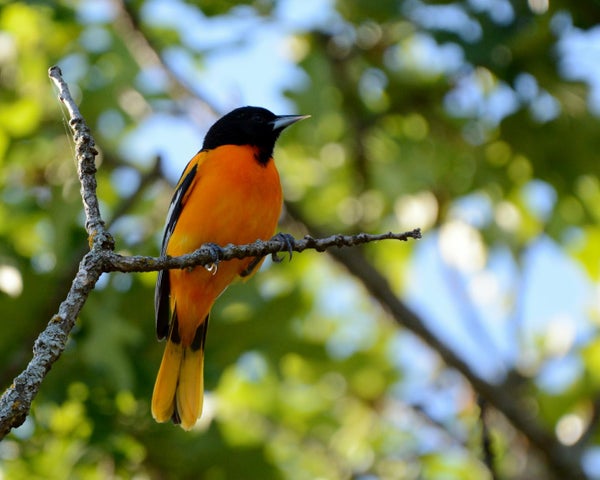
Megan Napoli, a research ecologist with the Mohonk Preserve in New York. Smiley’s efforts produced a rare long-term data set of observations. It’s ideal for studying the impacts of climate change, which often play out over the course of many decades and cause subtle changes in the timing of natural processes. For instance, other research has shown that songbirds are migrating north earlier and earlier in the spring.
“The reason that it’s important that the birds arrive at the proper time in the spring is because they need to time their arrival with the insect emergence. They need to be here to establish their territories, to establish their nesting sites, lay their eggs, and then once the egg hatch, and they have their nestlings, when the nestlings are in their nest, they need to time that with when the insects are most abundant.”
Napoli has begun analyzing roughly 76,000 observations of songbird migration dates collected by Smiley and his team to see if they too show that climate change has altered the timing of migrations. Her preliminary results suggest that they do.
Napoli found that short-distance migrants that spend their winters in the southern U.S. now arrive an average of 11 days earlier than they did in the 1930s. Long-distance migrants that overwinter in the tropics arrive roughly a week earlier. Napoli presented her results at a recent Ecological Society of America meeting in Portland, Oregon.
As in previous studies, Napoli also found a correlation between early arrivals and rising spring temperatures at Mohonk, which the Smiley family has been tracking since 1896. But she says there are still more questions about how and why the birds are migrating earlier, and Smiley’s data may hold more clues.
Meanwhile, who knows how many other long-term, personal data collections like Smiley’s are out there, waiting to be discovered—and to help bolster official attempts to track the planet’s changes.
—Julia Rosen
[The above text is a transcript of this podcast.]
*Editors Note (9/23/17): This story was changed after publication to correct and clarify the history of the Mohonk Preserve.
