New Issue: Orbital Catastrophe Ahead? Read Now

Twin Birth Proposed for Colliding Black Holes That Produced Gravitational Waves

A flash of light shortly after the detection of gravitational waves could mean that that historic event has an added wrinkle—the black holes that collided may have been born in the same collapsing massive star.   


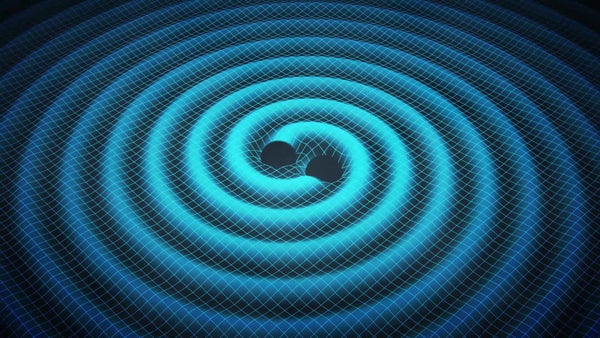
On Sept. 14, 2015, LIGO detected gravitational waves from two merging black holes, shown here in this artist's conception. The Fermi space telescope detected a burst of gamma rays 0.4 seconds later. New research suggests that the burst occurred because the two black holes lived and died inside a single, massive star.


Swinburne Astronomy Productions [HARVARD-SMITHSONIAN CENTER FOR ASTROPHYSICS]

Illustration of a Bohr atom model spinning around the words Science Quickly with various science and medicine related icons around the text

Join Our Community of Science Lovers!

The news last month that gravitational waves had been discovered made waves throughout the world of science. The finding, from the Laser Interferometer Gravitational-Wave Observatory, or LIGO, showed that extreme gravity can cause ripples in spacetime. In the case studied, the extreme gravity came from two colliding black holes. Now one scientist is suggesting an added wrinkle—that those two black holes might have originated in a single star.

“The situation is similar to a pregnant woman that has twin babies in her belly.” Avi Loeb of the Harvard-Smithsonian Center for Astrophysics. He’s proposing the idea in a paper that’s been accepted for publication in the Astrophysical Journal Letters. [Abraham Loeb, Electromagnetic Counterparts to Black Hole Mergers Detected by LIGO]

Loeb became suspicious because just 0.4 seconds after LIGO spotted the gravitational waves, a space telescope called Fermi glimpsed a bright flash of gamma-ray light in the same area of the sky.


On supporting science journalism

If you're enjoying this article, consider supporting our award-winning journalism by subscribing. By purchasing a subscription you are helping to ensure the future of impactful stories about the discoveries and ideas shaping our world today.


“Detecting such a signal is quite surprising from a collision of two black holes. What could be the source of a flash of light following a black hole merger?”

Colliding black holes should not produce such light—but the death of a very massive star could.

“My idea was that if the star is spinning very rapidly to start with, then as its core collapses it produces a bar that breaks into two clumps of matter, sort of like a dumbbell configuration. And these two clumps of matter orbit a common center, and they eventually collapse independently into two black holes.”

Of course, it’s possible that the Fermi telescope signal was a false alarm. So we’ll see if future gravitational wave detections are also accompanied by flashes of light—supporting the idea that twin black holes collided upon the collapse of a massive star.

—Clara Moskowitz

[The above text is a transcript of this podcast.]

Clara Moskowitz is chief of reporters at Scientific American, where she covers astronomy, space, physics and mathematics. She has been at Scientific American for more than a decade; previously she worked at Space.com. Moskowitz has reported live from rocket launches, space shuttle liftoffs and landings, suborbital spaceflight training, mountaintop observatories, and more. She has a bachelor’s degree in astronomy and physics from Wesleyan University and a graduate degree in science communication from the University of California, Santa Cruz.

More by Clara Moskowitz

Subscribe to Support Independent Journalism

Great science journalism requires human expertise, time, effort and creativity. And it costs money. That’s why I and the journalists here at Scientific American hope you’ll join our community.

When you subscribe, you are supporting staff and freelance journalists who are passionate about telling science stories that are true, important and compelling. Our editors and reporters are often experts in their fields, which means they understand the nuances of big discoveries and can untangle the breakthroughs from the hype. With a subscription, you are also supporting rigorous fact-checking to ensure the words we publish are precise and accurate. And you’re supporting original illustrations, graphics and photos that bring you closer to an advanced laboratory, an ice sheet in Antarctica or a space mission in orbit. You’re helping us craft other types of high-quality journalism as well: Our newsletters are carefully written, edited and curated by staffers you have or will come to know and love. Our Science Quickly podcast is based on original reporting, collaboration with editors and scientists and exacting production.

Subscriptions keep this engine running so we can continue to deliver thoughtful, rigorous and independent science journalism to you. In an era of viral misinformation, this work is crucial. If you value what we do, I hope you’ll consider joining us as a subscriber

Thank you,

Jeanna Bryner, Editor in Chief, Scientific American

Subscribe