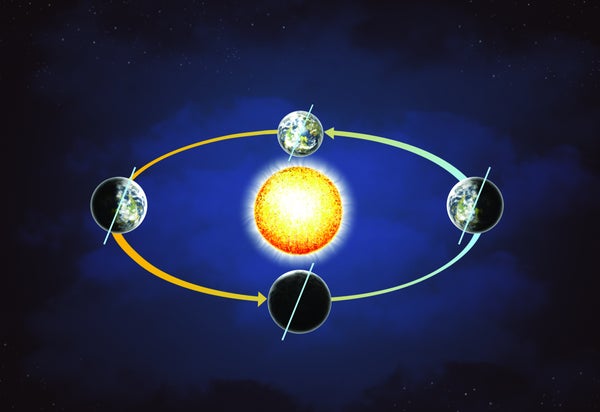
Happy New Year! And if you’ve been away from work for a few days, you deserve some time off. After all, you’ve traveled far. Even if you just stayed at home. According to NASA, just by being on the planet Earth in the last year, you’ve zipped about 584 million miles around the sun. At an average speed of about 67,000 miles per hour. [Siren sound.] Hey, I wasn’t speeding—in my inertial reference frame.
Of course, the trip was not a perfect circle. As Kepler showed, the Earth’s orbit is an ellipse, with the sun at one of the two focal points. He also figured out the planet goes faster when it’s at perihelion, nearer the sun, than when it’s at aphelion, its farthest distance. Which would explain why summer seems to zip by, except that the seasons are a function of the tilt of the Earth’s axis, not its different distances from the sun. And the Earth rotated 365 and a quarter times during its sweep around the sun. The trip took 8,766 hours. Or 525,960 minutes. Or 31,557,600 seconds. Tick tock.
—Steve Mirsky
On supporting science journalism
If you're enjoying this article, consider supporting our award-winning journalism by subscribing. By purchasing a subscription you are helping to ensure the future of impactful stories about the discoveries and ideas shaping our world today.
[The above text is a transcript of this podcast.]
Subscribe to Support Independent Journalism
Great science journalism requires human expertise, time, effort and creativity. And it costs money. That’s why I and the journalists here at Scientific American hope you’ll join our community.
When you subscribe, you are supporting staff and freelance journalists who are passionate about telling science stories that are true, important and compelling. Our editors and reporters are often experts in their fields, which means they understand the nuances of big discoveries and can untangle the breakthroughs from the hype. With a subscription, you are also supporting rigorous fact-checking to ensure the words we publish are precise and accurate. And you’re supporting original illustrations, graphics and photos that bring you closer to an advanced laboratory, an ice sheet in Antarctica or a space mission in orbit. You’re helping us craft other types of high-quality journalism as well: Our newsletters are carefully written, edited and curated by staffers you have or will come to know and love. Our Science Quickly podcast is based on original reporting, collaboration with editors and scientists and exacting production.
Subscriptions keep this engine running so we can continue to deliver thoughtful, rigorous and independent science journalism to you. In an era of viral misinformation, this work is crucial. If you value what we do, I hope you’ll consider joining us as a subscriber