
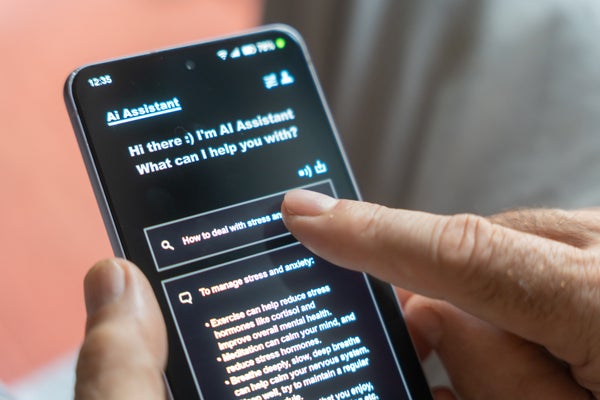
People are increasingly consulting artificial intelligence for mental health advice. According a new survey conducted by the American Psychological Association (APA), as many as 77 percent of U.S. psychologists reported that their patients are using AI. Some employ chatbots for fun or companionship, but many others use them to support their mental health care—from attempting to self-diagnose conditions to helping with self-discipline. Of the more than 1,200 psychologists surveyed, 35 percent reported having patients who use AI as an auxiliary therapist.
Most of the survey respondents said they worry about potential harms the technology could have on their patients: these possible negative consequences included encouraging self-harm, providing misinformation and causing dependence on the chatbots. The survey results reflect psychologists’ understanding that current AI chatbots aren’t up for the task of providing mental health support, says Arthur Evans, CEO of the APA, “and that using [AI] for that purpose has very serious risks.”
The survey data don’t reveal how often people turn to AI for mental health support in general; they only demonstrate how it shows up in established therapy relationships. But another survey published last year by George Mason University found that 54 percent of people across age groups reported using AI to manage stress, anxiety or mental health needs and that 15 percent reported doing so on a daily basis. Other recent surveys have found that around 12 or 13 percent of adolescents turn to AI for mental support.
On supporting science journalism
If you're enjoying this article, consider supporting our award-winning journalism by subscribing. By purchasing a subscription you are helping to ensure the future of impactful stories about the discoveries and ideas shaping our world today.
In the new survey, more than a third of psychologists whose patients use AI for therapy or companionship said these individuals had some level of dependency on the chatbots. And 15 percent reported that their patients developed delusional thinking associated with the AI use.
Marie Bragg, a psychologist and population health researcher at NYU Langone Health, who was not involved with the new survey, says that her patients who are college-age or younger frequently bring up how they are using AI. Often, she says, they ask it for input related to their relationships and mental health, including to get information about symptoms.
“The idea that it’s available 24/7 is appealing because it means when they’re stressed about something or they have a question in the night, they can go and ask it,” Bragg says.
But AI chatbots, which are based on large language models (LLMs) that predict strings of text, were not built for use in therapy. “In fact, some of the features that these chatbots have are actually antithetical to what a clinician would do,” Evans says. One of the main culprits is the models’ propensity for sycophancy. AI chatbots tend not to push back on the way users frame or present ideas, which results in a frictionless customer experience but potentially reinforces harmful patterns of thinking.
“Therapy naturally involves gentle friction,” says Mitch Prinstein, senior science adviser for the APA and a professor at the University of North Carolina at Chapel Hill. But AI doesn’t challenge people to pause, reflect and reconsider their views the way a human therapist would. “It’s destined to not provide what’s needed in relationships—including therapist-patient relationships,” Prinstein says.
Another problem stems from how anthropomorphic AI chatbots are, Evans says. These programs are designed to sound convincingly human, which can make them seem trustworthy and authoritative. They may also mirror the way a person speaks with them, giving that person a sense of “false intimacy,” Prinstein adds. But despite this perceived trustworthiness, chatbots can present incorrect information, including about medical conditions, a combination that Evans finds particularly worrisome. Research has also shown that AI chatbots reproduce stigmatized messages about certain mental health conditions such as alcoholism and schizophrenia.
“This is where my concern around the business model of chatbots intersects with my concerns around about patient care,” Bragg says. Commercial AI models are designed to keep users on the platform—hence these qualities of sycophancy and anthropomorphism, which may make users feel good, she says. But “when the platform is optimized for engagement, it’s a different metric than optimizing for patient care.”
AI chatbots may eventually be capable of providing accessible and safe mental health support. “Psychologists are not opposed to taking that technology and then building on top of that,” Evans says. “But it’s going to take a lot of work, and we don’t see that [level of expertise and safety in] anything on the market right now.”
The APA recently launched a “digital badge” program that reviews and rates the scientific backing and privacy protections for existing digital mental health tools, including AI products. “I think that the companies themselves just have to pay more attention to this,” Evans says. “They make these technologies for the general public, but within the general public are people who have these specific [mental health] conditions” that put them at greater risk of harm.
Along with the survey, the APA published a guide for navigating AI-generated advice. In it, an expert advisory group led by Prinstein suggests a number of tactics for engaging with AI advice more safely. These include asking chatbots for “evidence-based” responses and being careful about invisible assumptions in how questions are framed.
In general, the APA’s guide recommends not taking AI advice at face value, bringing what you learn to licensed mental health professionals and being skeptical if chatbots start suggesting you pull away from real-world relationships.
“Be careful if something is trying really hard to develop a relationship with you while [the company making it is] trying to make a profit from your interactions and your data,” Prinstein says.