New Issue: Orbital Catastrophe Ahead? Read Now

15 Million Years before the Megalodon, This Giant Ancient Shark Prowled the Oceans

A humungous shark that lived 115 million years ago surpassed the size of modern-day great whites, paleontologists discovered

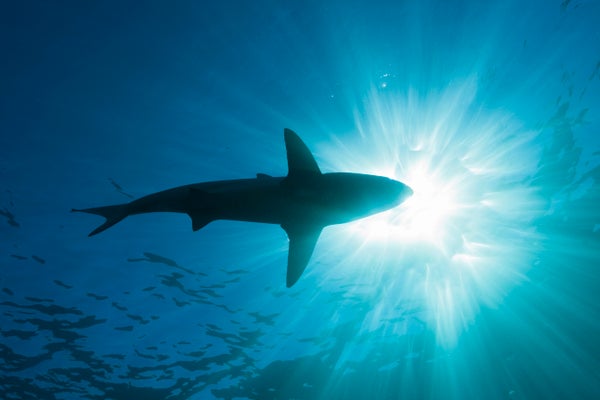
Blacktip Shark (Carcharhinus limbatus) - stock photo

Reinhard Dirscherl via Getty Images

Join Our Community of Science Lovers!

Before the famously huge megalodon, another fearsome ocean predator roamed the seas. According to a paper published earlier this year in Communications Biology, a massive shark that exceeded the size of modern-day great whites prowled the water off what is now Australia 15 million years before the megalodon arose.

By analyzing a set of five vertebrae found on an Australian beach, paleontologists estimated that this ancient shark likely spanned about eight meters in length—for comparison, great white sharks tend to grow to around six meters today.

“It would’ve looked for all the world like a modern, gigantic shark, because this is the beauty of it,” said Benjamin Kear, a senior curator at the Swedish Museum of Natural History and a study co-author, to the Associated Press. “This is a body model that has worked for 115 million years, like an evolutionary success story.”


On supporting science journalism

If you're enjoying this article, consider supporting our award-winning journalism by subscribing. By purchasing a subscription you are helping to ensure the future of impactful stories about the discoveries and ideas shaping our world today.


Although sharks have a 450-million-year-long history on Earth, the ancestors of modern great whites don’t show up in the fossil record until 135 million years ago. And crucially, these ancestors were typically small fry—just a meter or so in length. Older discoveries had suggested that truly giant sharks such as megalodons (which could reach 17 meters) evolved around 100 million years ago. But the new analysis suggests that giant sharks came on the scene earlier than previously thought.

The team behind the discovery now plans to look for other ancient giant shark remains to try and color in some more of sharks’ evolutionary tree.

“They must have been around before,” Kear told the AP. “This thing had ancestors.”

Subscribe to Support Independent Journalism

Great science journalism requires human expertise, time, effort and creativity. And it costs money. That’s why I and the journalists here at Scientific American hope you’ll join our community.

When you subscribe, you are supporting staff and freelance journalists who are passionate about telling science stories that are true, important and compelling. Our editors and reporters are often experts in their fields, which means they understand the nuances of big discoveries and can untangle the breakthroughs from the hype. With a subscription, you are also supporting rigorous fact-checking to ensure the words we publish are precise and accurate. And you’re supporting original illustrations, graphics and photos that bring you closer to an advanced laboratory, an ice sheet in Antarctica or a space mission in orbit. You’re helping us craft other types of high-quality journalism as well: Our newsletters are carefully written, edited and curated by staffers you have or will come to know and love. Our Science Quickly podcast is based on original reporting, collaboration with editors and scientists and exacting production.

Subscriptions keep this engine running so we can continue to deliver thoughtful, rigorous and independent science journalism to you. In an era of viral misinformation, this work is crucial. If you value what we do, I hope you’ll consider joining us as a subscriber

Thank you,

Jeanna Bryner, Editor in Chief, Scientific American

Subscribe