New Issue: Orbital Catastrophe Ahead? Read Now

2025 Wasn’t the Hottest Year on Record. Earth Is Still Barreling to the Climate Brink

Global warming surpassed 1.5 degrees Celsius for the past three years, meaning Earth is currently on track to breach the Paris climate agreement by the end of the decade

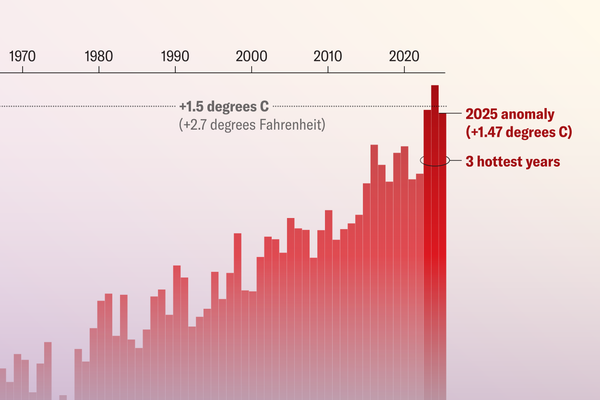
Cropped image of a bar chart shows temperature anomalies over time and highlights the three hottest years: 2023, 2024 and 2025.

Amanda Montañez; Source: Copernicus Climate Change Service (data)

Join Our Community of Science Lovers!

First, the good news: 2025 was not the hottest year on record. Now the bad news: last year was the third hottest on record, just a hair behind 2023. More importantly, it caps three years when global temperatures have surpassed 1.5 degrees Celsius above preindustrial levels.

The data, released by the European Union’s Copernicus Climate Change Service (C3S) on Tuesday, suggest we stand on a climate precipice.

“These three years stand apart from those that came before,” said Samantha Burgess, deputy director of C3S, in a press conference on Monday.


On supporting science journalism

If you're enjoying this article, consider supporting our award-winning journalism by subscribing. By purchasing a subscription you are helping to ensure the future of impactful stories about the discoveries and ideas shaping our world today.


The past 11 years have been the 11 hottest on record, underscoring a global warming trend driven by rising levels of greenhouse gases in the atmosphere. If this trajectory doesn’t rapidly change, the world is on track to breach the landmark 2015 Paris climate agreement, which enjoins countries to limit warming to below 1.5 degrees C and “well below” two degrees C.
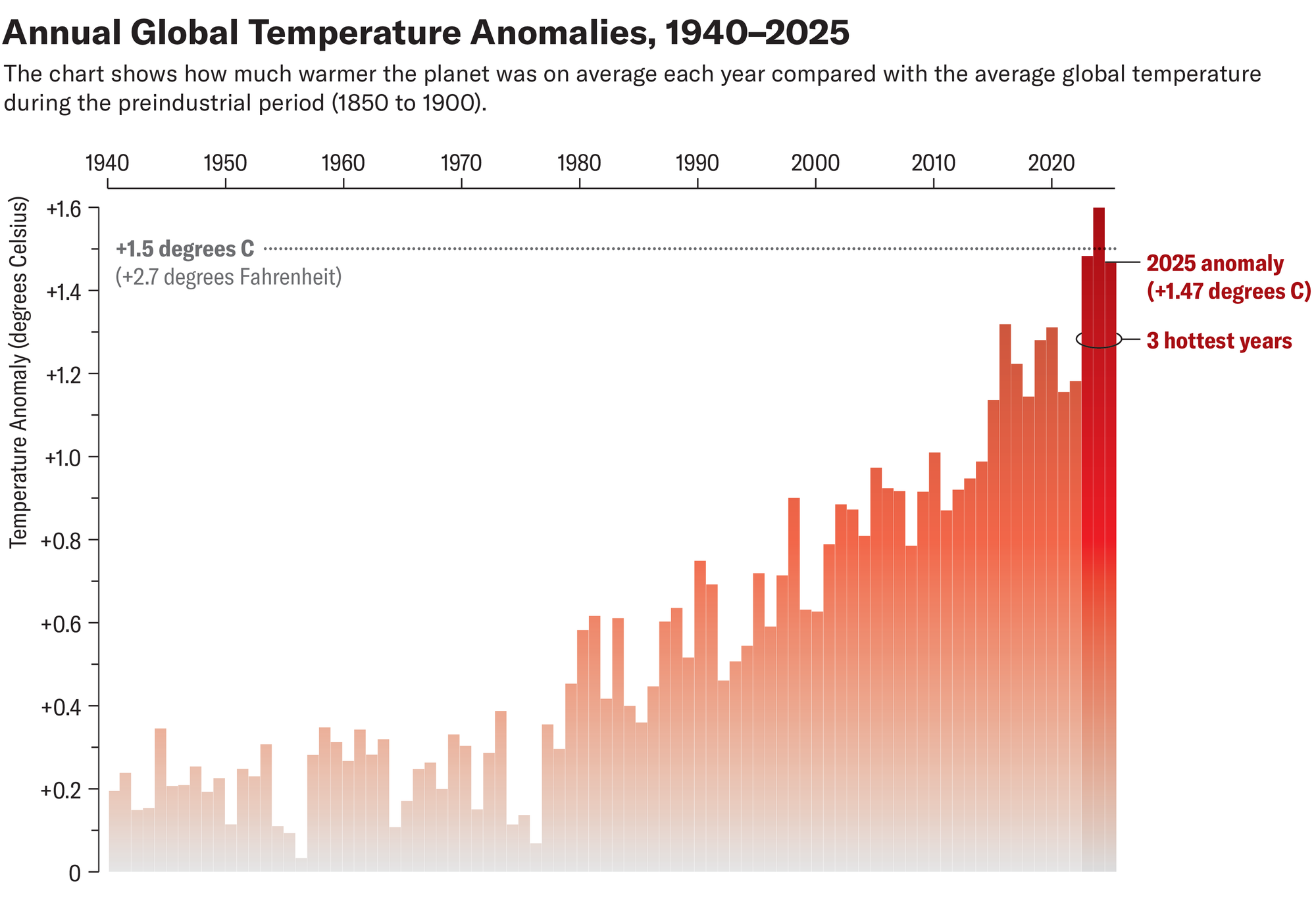
	Bar chart shows annual global temperature anomalies from 1940 through 2025, compared with the preindustrial period’s average global temperature.

Amanda Montañez; Source: Copernicus Climate Change Service (data)

The global average temperature for 2025 was 1.47 degrees C above the average from 1850 to 1900, according to C3S. That’s just 0.01 degree C cooler than 2023; 2024 retains the title of hottest year on record, at 1.6 degrees C above the preindustrial global average—the first year to exceed 1.5 degrees C.

The Paris Agreement considers temperatures averages over many years. That’s why hitting a three-year warming milestone—and having the hottest years bunched over the past decade—is crucial evidence to show we are nearing a breach, likely by the end of this decade. That’s more than a decade sooner than was predicted when the agreement was first negotiated, C3S found.

“The world is rapidly approaching the long-term temperature limit set by the Paris agreement. We are bound to pass it; the choice we now have is how to best manage the inevitable overshoot and its consequences on societies and natural systems,” said Carlo Buontempo, C3S’s director, in a statement.

Achieving the goals of the Paris Agreement has been made all the harder by the Trump administration, which has sought to curtail U.S. climate action at home and abroad. As his current term began one year ago, President Donald Trump moved to pull the U.S. out of the agreement—an action he had taken in his first administration. And just a week ago Trump announced that he would go one step further, taking the U.S. out of the climate treaty under which the Paris accord was negotiated, as well as several other related agreements.

Andrea Thompson is senior editor for Earth and environment at Scientific American, covering the environment, energy and Earth sciences. She has been covering these topics for nearly two decades. Prior to joining Scientific American, she was a senior writer covering climate science at Climate Central and a reporter and editor at Live Science, where she primarily covered earth science and the environment. She has moderated panels, including as part of the United Nations Sustainable Development Media Zone, and appeared in radio and television interviews on major networks. She holds a graduate degree in science, health and environmental reporting from New York University, as well as a B.S. and an M.S. in atmospheric chemistry from the Georgia Institute of Technology. Follow Thompson on Bluesky @andreatweather.bsky.social

More by Andrea Thompson

Subscribe to Support Independent Journalism

Great science journalism requires human expertise, time, effort and creativity. And it costs money. That’s why I and the journalists here at Scientific American hope you’ll join our community.

When you subscribe, you are supporting staff and freelance journalists who are passionate about telling science stories that are true, important and compelling. Our editors and reporters are often experts in their fields, which means they understand the nuances of big discoveries and can untangle the breakthroughs from the hype. With a subscription, you are also supporting rigorous fact-checking to ensure the words we publish are precise and accurate. And you’re supporting original illustrations, graphics and photos that bring you closer to an advanced laboratory, an ice sheet in Antarctica or a space mission in orbit. You’re helping us craft other types of high-quality journalism as well: Our newsletters are carefully written, edited and curated by staffers you have or will come to know and love. Our Science Quickly podcast is based on original reporting, collaboration with editors and scientists and exacting production.

Subscriptions keep this engine running so we can continue to deliver thoughtful, rigorous and independent science journalism to you. In an era of viral misinformation, this work is crucial. If you value what we do, I hope you’ll consider joining us as a subscriber

Thank you,

Jeanna Bryner, Editor in Chief, Scientific American

Subscribe