
The best stories are those that draw you in with intrigue, visuals and characters, leaving you with a new perspective on the world and your place in it. My take on flowers is forever changed after reading science journalist Maryn McKenna’s deep dive into the chemically laden, international floral industry, where loose to nil regulations on insecticides and fungicides allow farms to create the perfect blossom. These chemicals are used at such high levels on flower farms in countries such as Ecuador and Ethiopia that they lead to cognitive and physical ailments for workers, neighbors living nearby, and even people handling the blooms thousands of miles away. The good news: Farms across the globe are bringing pesticide-free flowers with local character into fashion. For me: I’m letting go of my love for perfectly round and bright peonies.
Cute little White-throated Sparrows hold a treasure trove of mind-shifting qualities. Contrary to conventional wisdom, the flashier figure in a mating pair is sometimes male and sometimes female. Referred to as “the bird with four sexes,” the sparrows come in four varieties based on their sex organs and color morph (white-striped or tan striped). Regardless of biological sex, the white-striped morph aggressively defends territory, and the drab tan striped morph is the nurturing parent. Neuroscientist Donna L. Maney reveals the fascinating genetics underlying these morphs, ultimately challenging the idea that life fits into binary boxes of male and female. I hope your binocular view of backyard birds is a little more spectacular after reading Maney’s article.
Astronomers looking at the heavens through behemoth telescopes have found something missing from the parade of planets discovered since 1995 outside of our solar system: a dearth of worlds a tad larger than Earth but quite a bit smaller than Neptune. Astrophysicist Dakotah Tyler says that some atmosphere-stripping force could be preventing intermediate-size planets from forming or keeping their middleweight girth. The answers not only will resolve an astronomical puzzle but also could enlighten our view of Earth’s (and our own) place in the universe.
On supporting science journalism
If you're enjoying this article, consider supporting our award-winning journalism by subscribing. By purchasing a subscription you are helping to ensure the future of impactful stories about the discoveries and ideas shaping our world today.
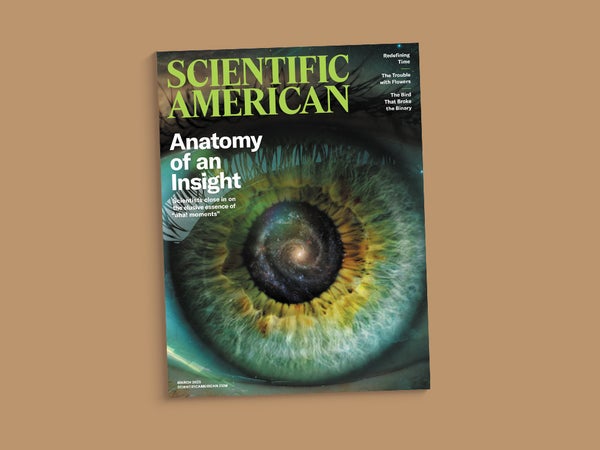
Our cover story tells in wondrous detail how, after more than a century of searching, scholars have discovered the neurological and psychological sources of insight. Psychologist John Kounios and writer Yvette Kounios describe why insightful thinking is beneficial and feels good. If you are struggling to solve a puzzle or dilemma, anxiety, lack of sleep and the modern drive for productivity can be your enemies: Find somewhere you can relax and allow your brain to loosen its grip on old ways of thinking. You may be surprised at what you can imagine.
Journalist Rachel Parsons delivers a compelling case from farmers and researchers who are part of the salty food movement. It’s not an endorsement of potato chips. These foods are made from halophytes, which are adept at growing in highly saline soils resulting partly from drought and sea-level rise. The salty conditions have eliminated millions of acres of crops from production. Will such salt-tolerant plants be the answer? The primary barrier seems to be humans’ narrow view of what counts as delicious food.
I’ll leave you with a question you might need a minute to wrap your head around: Should humanity redefine time or, more specifically, the second? That’s what physicists are grappling with in science writer Jay Bennett’s feature. As atomic clocks advance, scientists can measure a second tens of thousands of times more accurately than with the standard method using cesium atoms. The implications of the decision could have timely and interesting repercussions.