
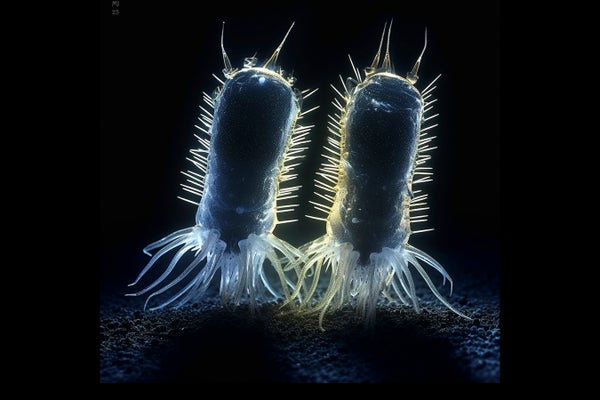
Rocks hundreds of metres beneath the Australian Outback have yielded clues to a lost world of primitive microbes that once populated the world’s oceans and might have eventually given rise to modern plants and animals.
Analysis of fat-like molecules isolated from the rocks suggests that they were made by a previously undiscovered, ancient population of organisms called eukaryotes, the group of living things whose cells typically contain a nucleus and other internal compartments. The molecules are 1.6 billion years old and hint that eukaryotes were abundant and widespread much longer ago than earlier biochemical evidence had suggested.
“The previous story was that eukaryotes were extremely rare until 800 million years ago,” says Phoebe Cohen, a palaeobiologist at Williams College in Williamstown, Massachusetts, who was not involved in the research. “Palaeontologists really bristled at that, because that’s not what we were seeing in the fossil record.” The findings, she says, help to bridge the gap between the two types of evidence.
On supporting science journalism
If you're enjoying this article, consider supporting our award-winning journalism by subscribing. By purchasing a subscription you are helping to ensure the future of impactful stories about the discoveries and ideas shaping our world today.
The new results were published on 7 June in Nature.
Chemical fingerprint
Most modern eukaryotes rely on fat-like compounds called sterols, such as cholesterol, to build cell membranes and carry out other cellular functions. Because sterols are found throughout the eukaryotic family tree, they are thought to have been present in the last common ancestor of all modern eukaryotes. For that reason, palaeontologists have used the compounds as a biomarker for the presence of eukaryotes in ancient rocks.
But look further back in time than 800 million years ago, and the sterol-trail runs dry. Researchers have not been able to find traces of the compounds in rocks older than that, despite the existence of fossils of a red and a green alga — both eukaryotes — dating back about one billion years.
This absence has led to speculation that before 800 million years ago, eukaryotes were not abundant enough to leave a detectable sterol trace.
Another possibility, however, was that researchers were looking for the wrong molecules. Benjamin Nettersheim, a geobiologist at the University of Bremen in Germany, Jochen Brocks, a palaeobiogeochemist at the Australian National University in Canberra, and their colleagues decided to focus on short-lived molecules that modern eukaryotes make while synthesizing sterols. Such modern intermediates might have been the end product for primeval eukaryotes.
Wild ocean
The team combed rocks from around the world and found widespread traces of these ‘protosterols’ — evidence that the eukaryotes that produced them were abundant in water environments between 800 million and 1.6 billion years ago.
This contradicts previous thinking, says Nettersheim. One possibility is that eukaryotes that make more-modern sterols gained a selective advantage between one billion and 800 million years ago, eventually displacing their protosterol-making counterparts.
The work could show why scientists could not find biochemical traces to confirm the fossil record, says Laura Katz, a biologist who studies microbial eukaryotes at Smith College in Northampton, Massachusetts. “We were just looking for the wrong thing.”
But Andrew Roger, who studies comparative genomics and the evolution of eukaryotes at Dalhousie University in Halifax, Canada, notes that fossilized red and green algae dating back one billion years look remarkably similar to living algae, and probably made modern sterols. That would suggest that modern sterols — not just their precursors — should also be present in rocks that are more than 800 million years old. “The finding raises as many questions as it answers,” he says.
And although there are reasons to suspect that the protosterols were made by eukaryotes, the researchers have not yet been able to rule out the possibility that they were made by ancient bacteria, says Susannah Porter, a palaeontologist who focuses on early eukaryote evolution at the University of California, Santa Barbara.
But the team’s approach — using hypotheses about the evolution of biosynthetic pathways to guide the search for ancient life — could reveal more about early life, she adds. “It’s thinking about the record of biomarkers from an evolutionary perspective,” Porter says. “And I think that’s needed.”
This article is reproduced with permission and was first published on June 7, 2023.