
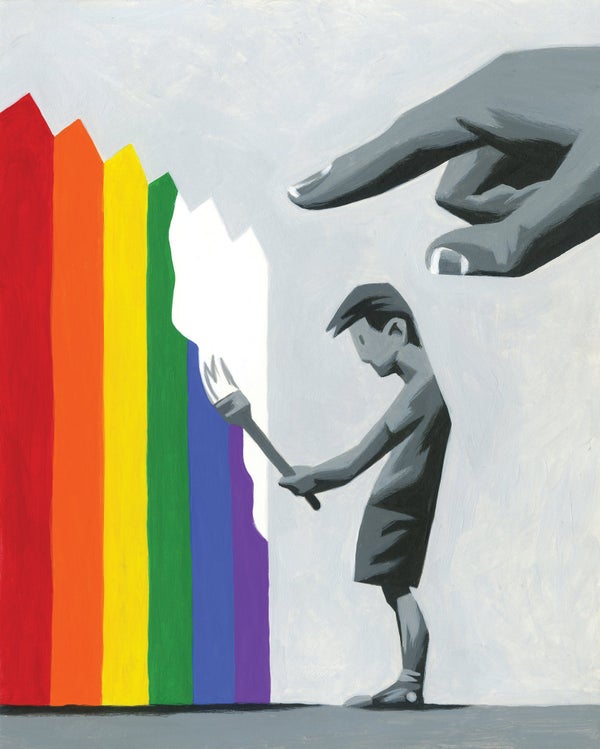
Last summer a South Carolina man named McKrae Game, who founded a network to promote “conversion therapy” for gay people, disavowed his own work. The Hope for Wholeness group Game established tries to help individuals follow his entreaty to attain “freedom from homosexuality through Jesus Christ.” But Game, who revealed that he was gay last year, pleaded on Facebook: “I WAS WRONG! Please forgive me!”
It might be assumed from this refutation that any attempts to forcibly change a young person's sexual orientation are about to go the way of bloodletting, frontal lobotomy and trepanation. But that supposition would be wrong: if past trends hold, 16,000 LGBTQ—lesbian, gay, bisexual, transgender and queer—teenagers in the U.S. will go through conversion therapy before they turn 18, according to the Williams Institute at the U.C.L.A. School of Law, and only 18 states have banned this harmful practice for minors.
Some conservative religious organizations still back “anti-gay therapy” and on occasion end up in court to defend it. Their chances of prevailing have been bolstered by an increasingly right-leaning judiciary fostered by the nation's red/blue divide.
On supporting science journalism
If you're enjoying this article, consider supporting our award-winning journalism by subscribing. By purchasing a subscription you are helping to ensure the future of impactful stories about the discoveries and ideas shaping our world today.
The reason no minor should be subjected to this practice has nothing to do with partisan politics or religious beliefs. The putative therapy should be discarded because it is rooted in bad science. Its origins are tied to both rejected concepts about sexuality and therapies based on those discredited notions.
Homosexuality—once explained erroneously as the result of an overbearing mother—was classified as a form of mental illness in psychiatry's first diagnostic manual, published in 1952. In the past, treatments to “cure” it included electroshock, chemical therapies such as the forced hormone treatments infamously inflicted on British mathematician Alan M. Turing, and the hiring of prostitutes for “behavioral” interventions. But milder versions persist today in the form of aggressive counseling and, at times, the administration of measures that induce nausea or vomiting.
Trying to alter an individual's sexual identity should be banned simply because of the irreparable harm it causes. In a 2019 survey of almost 35,000 young people, the Trevor Project, which provides crisis intervention for LGBTQ youths, found that 42 percent of a subgroup who had received conversion therapy attempted suicide.
The medical establishment, thankfully, has become a solid critic of anti-gay conversion. The American Medical Association, the American Psychological Association and other organizations characterize it as useless and injurious. The public is also opposed: a 2019 Reuters/Ipsos national poll found that 56 percent of U.S. adults think conversion therapy should be illegal.
Although medical and psychological associations have asked explicitly that Congress and state governments ban anti-gay conversion, there has been a backlash from groups such as the Liberty Counsel, which promotes “evangelical values.” Listed by the Southern Poverty Law Center (SPLC) as an anti-LGBTQ hate group, the Liberty Counsel noted in a press release that it is fighting several existing bans on conversion therapy. Luckily, verdicts can go both ways: in a 2015 case brought by the SPLC, a New Jersey state court ruled that Jews Offering New Alternatives for Healing—tellingly abbreviated as JONAH—had engaged in consumer fraud by offering conversion therapy because homosexuality is not a mental illness.
The best way to stop this practice is through a federal resolution or through additional bans by the other 32 states—or even by local jurisdictions. Bills have been introduced to put a ban in place at the federal level, but these are still languishing in the House of Representatives.
Time may be running out. New York City had a ban but voted to undo it in September 2019: the City Council feared that a lawsuit to quash the ban, filed by another Christian advocacy group, might make its way up to an ever more conservative Supreme Court that could rule against the injunction. Whether this detestable practice continues may depend on the 2020 presidential and congressional elections—which, depending on the outcome, might provide an opening for legislation to finally put an end to a pseudoscientific technique masquerading as therapy.