A New Map Tracks the World’s Largest Glaciers

A visualization compares the forms of Earth’s largest flows of ice

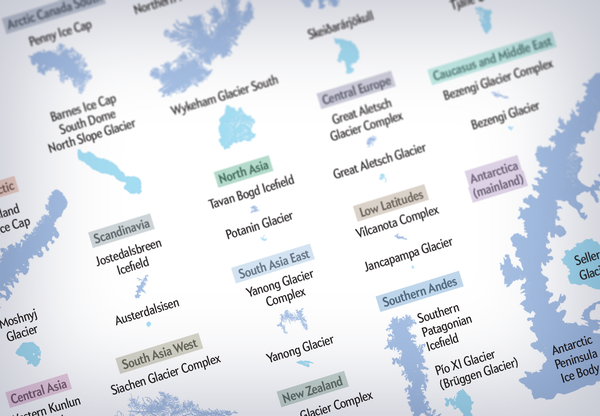
Graphic shows shapes and sizes of the largest glaciers and glacier complexes in each of 19 world regions.

Amanda Montañez

Join Our Community of Science Lovers!


On supporting science journalism

If you're enjoying this article, consider supporting our award-winning journalism by subscribing. By purchasing a subscription you are helping to ensure the future of impactful stories about the discoveries and ideas shaping our world today.


Scientists recently created the first systematic ranking of Earth’s largest glaciers. They started by comparing inconsistent databases to select the forms that best fit the definition of a glacier—a long-lasting, flowing mass of ice. Determining the borders of individual glaciers, however, is challenging. Ice caps, for example, move in multiple directions, so more than one glacier may be part of a single source. “Flow divides can be difficult to calculate,” says co-author Bruce Raup of the U.S. National Snow and Ice Data Center (NSIDC).

At lower elevations, glaciers can converge, making it unclear whether they count as one or more bodies. Despite the challenges, the results tabulate more than 200,000 glaciers and glacier complexes (glaciers that share a common border). Seller Glacier and the Antarctic Peninsula Ice Body top the list, respectively. “The more accurately we can map glacier outlines, the better we can track their melting due to climate change,” says lead author Ann Windnagel of the NSIDC.
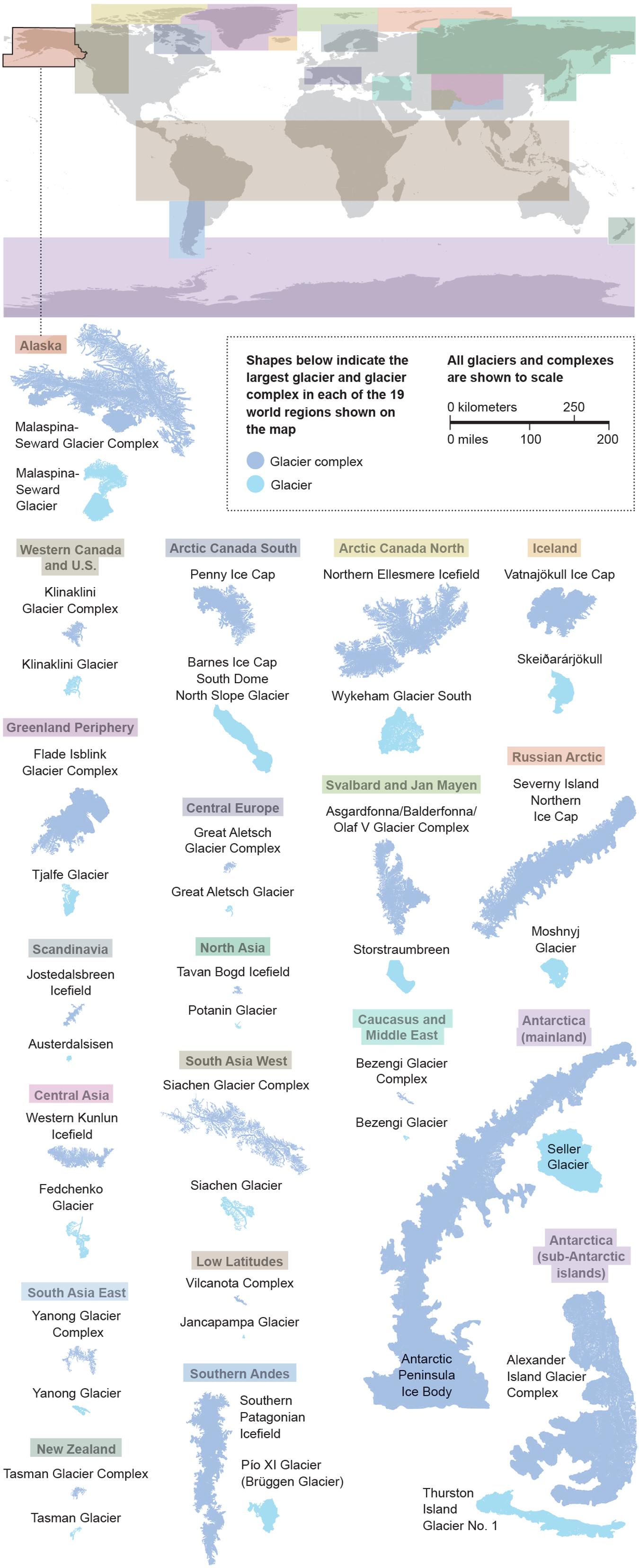
Credit: Amanda Montañez; Source: “Which Glaciers Are the Largest in the World?” by Ann Windnagel et al., in Journal of Glaciology; 2022 (glacier shapes and map reference)

Theo Nicitopoulos is a freelance writer who covers Earth and space science news.

More by Theo Nicitopoulos

Amanda Montañez is senior graphics editor and been at Scientific American since 2015. She produces and art directs information graphics for the Scientific American website and print magazine. Montañez has a bachelor's degree in studio art from Smith College and a master's in biomedical communications from the University of Toronto. Before starting in journalism, she worked as a freelance medical illustrator. Follow her on Bluesky @unamandita.bsky.social

More by Amanda Montañez
Scientific American Magazine Vol 328 Issue 1This article was published with the title “World's Largest Glaciers” in Scientific American Magazine Vol. 328 No. 1 (), p. 62
doi:10.1038/scientificamerican0123-62

It’s Time to Stand Up for Science

If you enjoyed this article, I’d like to ask for your support. Scientific American has served as an advocate for science and industry for 180 years, and right now may be the most critical moment in that two-century history.

I’ve been a Scientific American subscriber since I was 12 years old, and it helped shape the way I look at the world. SciAm always educates and delights me, and inspires a sense of awe for our vast, beautiful universe. I hope it does that for you, too.

If you subscribe to Scientific American, you help ensure that our coverage is centered on meaningful research and discovery; that we have the resources to report on the decisions that threaten labs across the U.S.; and that we support both budding and working scientists at a time when the value of science itself too often goes unrecognized.

In return, you get essential news, captivating podcasts, brilliant infographics, can't-miss newsletters, must-watch videos, challenging games, and the science world's best writing and reporting. You can even gift someone a subscription.

There has never been a more important time for us to stand up and show why science matters. I hope you’ll support us in that mission.

Thank you,

David M. Ewalt, Editor in Chief, Scientific American

Subscribe