
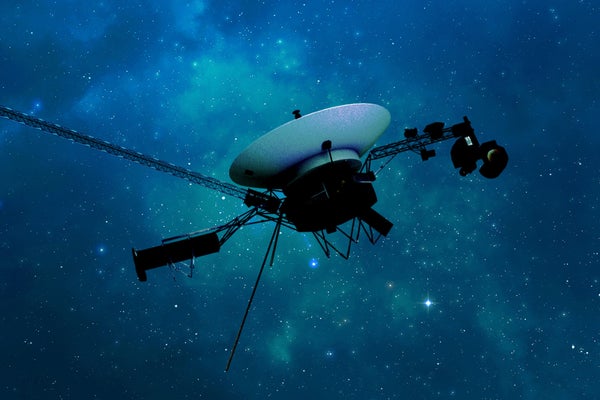
After months of nonsensical transmissions from humanity’s most distant emissary, NASA’s iconic Voyager 1 spacecraft is finally communicating intelligibly with Earth again.
Voyager 1 launched in 1977, zipped past Jupiter and Saturn within just a few years and has been trekking farther from our sun ever since; the craft crossed into interstellar space in 2012. But in mid-November 2023 Voyager 1’s data transmissions became garbled, sending NASA engineers on a slow quest to troubleshoot the distant spacecraft. Finally, that work has paid off, and NASA has clear information on the probe’s health and status, the agency announced on April 22.
“It’s the most serious issue we’ve had since I’ve been the project manager, and it’s scary because you lose communication with the spacecraft,” said Suzanne Dodd, Voyager project manager at NASA’s Jet Propulsion Laboratory in an interview with Scientific American when the team was still tracking down the issue.
On supporting science journalism
If you're enjoying this article, consider supporting our award-winning journalism by subscribing. By purchasing a subscription you are helping to ensure the future of impactful stories about the discoveries and ideas shaping our world today.
The Voyager 1 spacecraft is a scientific legend: It discovered that Jupiter’s moon Io, far from being a dead world like our own companion, is instead a supervolcanic world. The craft’s data suggested that Saturn’s moon Titan might have liquid on its surface. And for more than a decade, Voyager 1 has given scientists a glimpse at what space looks like beyond the influence of our sun.
Yet its long years in the harsh environment of space have done a number on the probe, which was designed to last just four years. In particular, degraded performance and low power supplies have forced NASA to turn off six of its 10 instruments, and its communication has gotten even spottier than can be explained by the fact that cosmic mechanics mean a signal takes nearly one Earth day to travel between humans and the probe.
When the latest communications glitch occurred last fall, scientists could still send signals to the distant probe, and they could tell that the spacecraft was operating. But all they got from Voyager 1 was gibberish—what NASA described in December 2023 as “a repeating pattern of ones and zeros.” The team was able to trace the issue back to a part of the spacecraft’s computer system called the flight data subsystem, or FDS, and identified that a particular chip within that system had failed.
Mission personnel couldn’t repair the chip. They were, however, able to break the code held on the failed chip into pieces they could tuck into spare corners of the FDS’s memory, according to NASA. The first such fix was transmitted to Voyager 1 on April 18. With a total distance of 30 billion miles to cross from Earth to the spacecraft and back, the team had to wait nearly two full days for a response from the probe. But on April 20 NASA got confirmation that the initial fix worked. Additional commands to rewrite the rest of the FDS system’s lost code are scheduled for the coming weeks, according to the space agency, including commands that will restore the spacecraft’s ability to send home science data.
Although, for now, Voyager 1 appears to be on the mend, NASA scientists know it won’t last forever. Sooner or later, a glitch they can’t fix will occur, or the spacecraft’s ever dwindling fuel supply will run out for good. Until then NASA is determined to get as much data as possible out of the venerable spacecraft—and its twin, Voyager 2, which experienced its own communications glitch earlier in 2023.