
In a first, scientists recovered human DNA from ancient cave paintings, a breakthrough that could open new ways to investigate prehistoric human activity by enabling caves to act as “genetic archives” that could reveal more about the ancient people who painted them.
The new research focused on caves in Spain and Portugal, but the technique could be applied anywhere. “The samples with better DNA, which allowed us to look into their genetic ancestry—these could be up to 16,000 years old," says geneticist Alba Bossoms Mesa, a doctoral student at the Max Planck Institute for Evolutionary Anthropology in Leipzig, Germany.
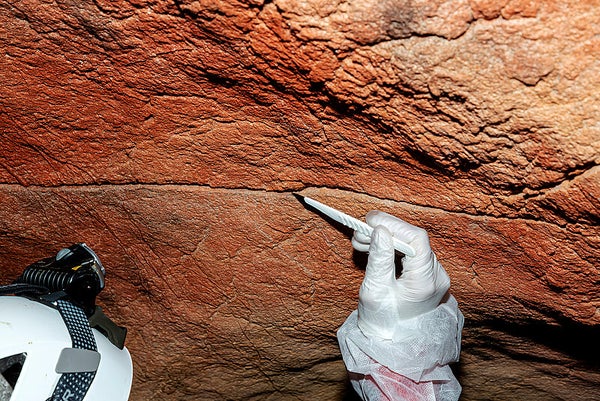
The researchers took samples of pigments from both ancient cave paintings and the surfaces of nearby unpainted rocks inside 11 caves. The findings, which were recently published in Nature Communications, could help date paintings in Spain’s Covarón Cave to the Upper Paleolithic period, which spanned from 50,000 to 12,000 years ago.
On supporting science journalism
If you're enjoying this article, consider supporting our award-winning journalism by subscribing. By purchasing a subscription you are helping to ensure the future of impactful stories about the discoveries and ideas shaping our world today.
Bossoms Mesa, the study’s first author, explains how the researchers took the samples while also preserving the paintings. In some cases, the scientists took tiny surface samples from areas that had already been damaged, while in others—such as in Spain’s famed Altamira Cave—water from above naturally flows over some of the ancient paintings, and that was collected for the research.
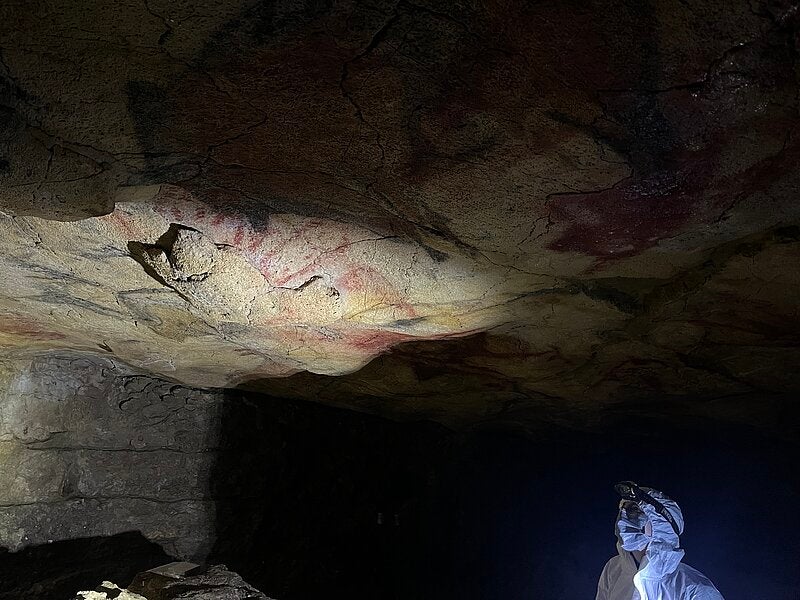
Polychrome ceiling of Altamira from which pigment samples were analyzed.
© Matthias Meyer
The researchers successfully recovered ancient human DNA in five samples taken from the caves. In most cases, it was mixed with ancient animal DNA—often from species such as bats and rodents. This mixed DNA was an important signal: the researchers believe it likely indicates that sediments from the cave floor were naturally transferred to the walls. By contrast, in Portugal’s Escoural Cave, the researchers found isolated human DNA that they believe came from the original artists—perhaps left by their touch when they rested their body on the wall, or from saliva or sweat during the painting process.
At Spain’s Covarón Cave, most of the samples were mixed animal and human DNA, but they contained much more ancient DNA than elsewhere. As a result, the researchers were able to trace the genetic ancestry of the people who once lived there.
Their analysis indicates that the cave paintings were probably made by hunter-gatherers who lived in Western and Central Europe sometime between 16,700 and 5,200 years ago. Unmixed human DNA from this period was found only on unpainted cave walls, so it’s unclear if it came from the artists.
Adam Brumm, an archaeologist at Australia’s Griffith University, who was not involved in the study, welcomes the results: “Several years ago we tried to extract ancient DNA from dated Late Pleistocene hand stencils in Sulawesi and Borneo,” he says. “We had no success, so I’m glad to see the promising results obtained by this team.”
Brumm was one of the scientists that found the world’s earliest-known cave art on Sulawesi, which is thought to be more than 67,800 years old.
“The demonstration that human DNA can persist on cave walls for thousands of years is encouraging,” he says. If successful, extracting ancient human DNA from rock art “will be a game changer that will revolutionize our understanding of early human culture.”