
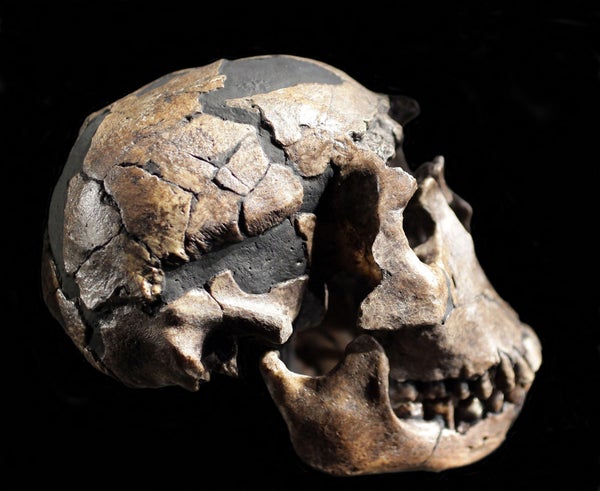
Fire was foundational to human evolution—cooking food over a fire eased digestion in early humans and made more energy available for the development of their brains; it also provided warmth and kept predators at bay. But exactly when and how ancient humans started using fire has long been a mystery. Now a new study in PLOS One finds evidence that an early hominin species, Homo erectus, likely used fire within caves as early as 1.79 million years ago.
The oldest evidence of ancient hominins actually making a fire came from a 400,000-year-old Neanderthal site in England. Earlier human ancestors such as H. erectus, however,likely couldn’t create fire from scratch and instead captured it from slow-burning bunches of grass, says anthropologist and study co-author Michael Chazan of the University of Toronto.
The analysis provides strong evidence for the earliest known fires, says Nick Ashton, an archaeologist at the British Museum, who was senior author of the Neanderthal research but was not involved in the new study. He notes, however, that the latter paper’s authors remain uncertain as to when the burning occurred, with the study giving a wide time range of between 1.79 million and 1.07 million years ago.
On supporting science journalism
If you're enjoying this article, consider supporting our award-winning journalism by subscribing. By purchasing a subscription you are helping to ensure the future of impactful stories about the discoveries and ideas shaping our world today.
Chazan and his colleagues have been studying the site—the Wonderwerk Cave in South Africa—for about two decades. In 2012 they found signs of fire use, including burned bones, ash and sediment, in the million-year-old Stratum 10 archaeological layer at the site where the cave is located. The team then turned its attention to finding evidence of burning in the layer below, Stratum 11, which is up to 1.79 million years old.
The team analyzed fossilized barn owl pellets and found changes in their texture and color that are associated with burning. And because the pellets were some 30 meters away from the cave’s entrance, the team could rule out their incineration by a natural wildfire. Rudimentary stone hand axes were also found in the Stratum 11 layer, and the researchers suggest that members of H. erectus who lived in the cave may have burned these pellets to make the fire last longer inside it.

Bones found at the cave—the bone on the far right is the most burnt, while the bone on the far left is unburnt.
Wonderwerk Cave Project
Chazan and his team also found ashy white bones that appeared to have been exposed to high heat, as well as what looked like charred black and brown bones. Because certain natural and chemical processes such as manganese staining or fluoridation can make fossilized bones look burned, the researchers used a technique called Fourier transform infrared (FTIR) spectroscopy to identify the organic and inorganic substances that were present in the dark-colored bones from Stratum 11 and found that four of them were burned.
The team also analyzed the gray-white bones using a luminescence technique that can reveal whether a bone has been burned or not—burned bones undergo chemical changes that enable them to absorb light of short wavelengths, such as blue light, and to emit light of a longer wavelength, such as red light. After exposing the bones to a high-energy blue light, the team used an optical filter to see which of them glowed red. That revealed that some 21 of the 39 white-grayish bones in Stratum 10 and all 32 from the layer below had been burned.
It’s impossible to know why these early human ancestors maintained a fire in the cave, Chazan says. Study co-author and geologist Yolanda Fernández-Jalvo of the National Museum of Natural Sciences in Spain rules out cooking within Wonderwerk because fire was only opportunistically brought there—it was not domesticated yet. But this summer, the researchers will look for additional clues and try to work out how H. erectus got the fire into the cave in the first place.