
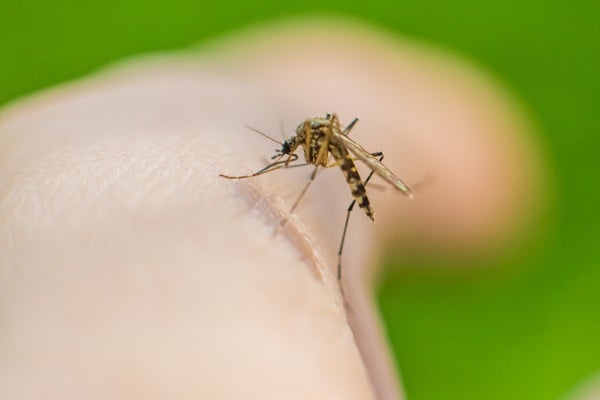
Mosquitoes are the deadliest animal on the planet, killing hundreds of thousands of people every year by transmitting malaria, dengue fever and a host of other deadly diseases. Understanding how the insects first got the taste for human blood has long intrigued scientists and could help us better fight the spread of mosquito-borne disease. Now a new study suggests that some mosquitoes’ thirst for human blood may be truly primeval, stretching back as far as 1.8 million years ago—a time when our ancient human ancestor Homo erectus may have been flourishing.
In the study, published on Thursday in Scientific Reports, an international team of researchers analyzed the DNA of 40 mosquitoes from 11 species of the Anopheles leucosphyrus group that are found in Southeast Asia. What makes this group of mosquito species so special is that some of the species have a strong preference for human blood, while others mostly feast on other primates, such as monkeys, gibbons and orangutans, says Upasana Shyamsunder Singh, a postdoctoral scholar at Vanderbilt University and lead author of the study.
The team calculated that the mosquitoes likely developed their “anthropophily”—their taste for human blood—at a point some 2.9 million to 1.6 million years ago. This overlaps with the same period in which some scientists believe H. erectus, an early hominin, arrived in the region.
On supporting science journalism
If you're enjoying this article, consider supporting our award-winning journalism by subscribing. By purchasing a subscription you are helping to ensure the future of impactful stories about the discoveries and ideas shaping our world today.
“The switch to human feeding was much older than we expected and so could not have been in response to the arrival of anatomically modern humans,” says Catherine Walton, a study co-author and a senior lecturer in Earth and environmental sciences at the University of Manchester in England.
For mosquitoes to have made a switch from other primates to hominins, ancient humans such as H. erectus “must not only have been present in this place and at this time but abundant,” she says.
The results aren’t just relevant for researchers who study human evolution; they’re also an important signal for epidemiologists who are looking to understand mosquito-borne diseases. These insects are still evolving, and humans are increasingly encroaching on wild areas—more mosquitoes could continue to adapt to prefer feasting on us over other animals.
“We are effectively creating novel selective pressures and we should expect mosquitoes to respond to these,” Walton says.