
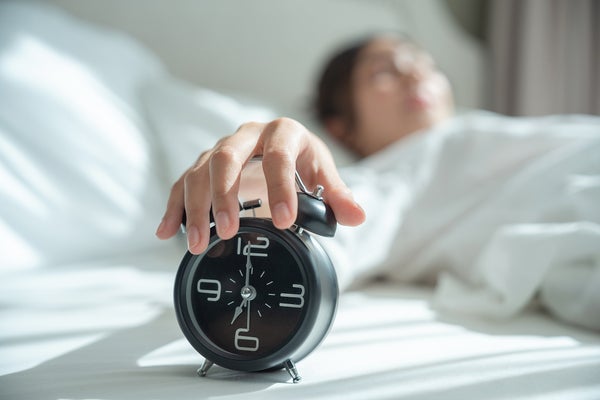
It’s midafternoon. You’re full from lunch. The day is warm. You’re starting to feel drowsy. Should you give in to the comfort of a nap?
From a health perspective, it may be worth it. Though there is some debate over whether napping benefits everyone, research suggests naps can boost at least some people’s cognitive performance in the short term. And a regular midday snooze might also have longer-term impacts, from a possible improvement in cardiovascular health to a bulwark against the loss of brain volume—potentially a protective factor against dementia.
“If you can fit in a nap of anything up to about 30 minutes, which isn’t really long, there seems to be fairly good evidence that you could be helping your brain age a little bit more healthily,” says Victoria Garfield, an epidemiologist at University College London.
Several studies find that a well-timed nap can provide a short-term boost in brainpower. For example, scientists reviewed past research that focused on healthy participants with regular sleep cycles. That review, published in 2009 in the Journal of Sleep Research, showed that napping improved factors ranging from reaction time to alertness to memory performance. A brief nap can also light the spark of creativity, a 2021 study in Science Advances found. In that research, participants were given math problems that could be solved with an easy shortcut that they weren’t told about. Some participants were encouraged to take a brief, dozy nap before tackling the problems. The researchers found those who napped—and spent even just 30 seconds in the first, lightest phase of sleep—were 2.7 times more likely to figure out the math shortcut than those who stayed awake. But entering a deeper sleep phase had a negative effect on this creative insight. In other words, there may be a “sweet spot” of mental relaxation that clears the way for eureka moments.
The benefits of napping are strongest for people who have sleep debt, meaning they don’t get enough nighttime sleep. Shift workers, new parents and older people with fragmented nighttime sleep all seem to get a boost: a 2014 review of research, for example, showed that taking a nap during one’s night-shift work reduced sleepiness and improved overall performance, even if people were slightly groggy as they came out of their nap—a phenomenon called “sleep inertia.”
Timing your naps right can reduce sleep inertia, says Natalie Dautovich, a psychologist at Virginia Commonwealth University and an environmental fellow at the National Sleep Foundation, which is primarily funded by pharmaceutical and medical device companies. A 20-minute nap is recharging, Dautovich says, and 60 to 90 minutes of sleep can be even more restorative. The nap to avoid is one lasting more than 20 minutes and less than 60 minutes, which, she says, is most likely to lead to sleep inertia.
The short-term benefits of naps are well established, but long-term effects are a little less clear. In particular, there has been debate about whether naps are good or bad for cardiovascular health after mixed epidemiological research was published on the topic. Self-reports of how frequently people nap and for how long are unreliable, Dautovich says, and pinning down the relationship between naps and any specific health outcomes is not always simple.
“The cause-and-effect association between napping and other health conditions is difficult to determine,” she says. “Greater daytime sleepiness is symptomatic of many health conditions, and therefore napping may not necessarily be the cause of these conditions but rather a consequence.”
For example, a 2021 study in the journal Alzheimer’s & Dementia found that long naps in older adults (who had a mean age of 81.4 years) was a risk factor for developing Alzheimer’s disease but that Alzheimer’s also led to longer and more frequent naps.
A 2017 review of research on the long-term health effects of napping, published in Sleep Medicine Reviews, found that studies in midlife adults showed napping to be associated with reduced coronary heart disease, cardiovascular disease and death from cardiovascular conditions. Short naps may lower blood pressure and heart rate and might also reduce the release of hormones such as adrenaline—all factors that could improve cardiovascular health—the review concluded. In adults around age 65 or older, however, some studies found that long naps of an hour or more were linked to a higher risk of cardiac problems. It’s possible these long naps were a symptom of early or undetected disease rather than a cause, the review authors cautioned.
Garfield and her colleagues at University College London have found that regular brief naps seem to improve brain health in the long run. Using data from the U.K. Biobank, which contains genetic and health information on 500,000 healthy people between the ages of 40 and 69, the team found that those who had genetic variations associated with regular napping also had a larger brain volume. All brains lose volume as they age, Garfield says, but greater losses are linked to conditions such as dementia, sleep apnea and higher levels of the stress hormone cortisol. Taking a nap regularly was equivalent to saving yourself between 2.6 and 6.5 years of aging, at least as far as brain volume was concerned, the researchers reported in Sleep Health.
Not everyone can nap, of course, Garfield says. And there are other similarly healthy habits that could fill 30 minutes a day, such as going on a walk or hitting the gym. But if it works for one’s schedule and personal preference, napping seems to be a healthy habit, not a sign of sloth.
“A trial-and-error approach can help many individuals determine whether napping is a useful behavior for themselves,” Dautovich says. “Schedule permitting, beginning with a brief afternoon nap of 20 minutes or less, several days a week, can be helpful to assess if napping improves mood or functioning or interferes with nocturnal sleep and to give your body time to develop a napping routine.”