
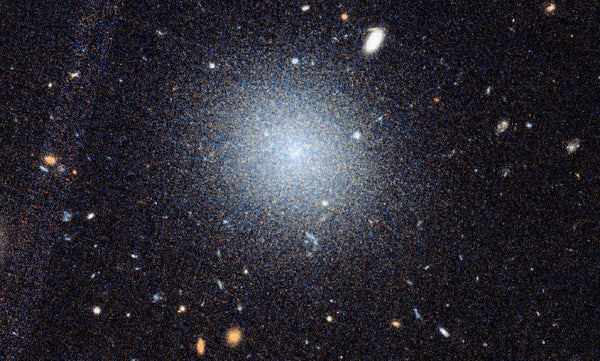
NASA calls dark matter the glue that holds the universe together—but the evidence is mounting that, at least in some galaxies, dark matter isn’t so necessary. A new study led by astronomers at Yale University has identified a galaxy that appears to contain almost no dark matter at all. This is the third galaxy of its kind to be found—two other galaxies were previously discovered to be devoid of the elusive adhesive.
This new galaxy, named DF9, was found lurking in the same thin chain of galaxies as the first two, called DF2 and DF4, although it is some 100 times dimmer. Using an instrument called the Keck Cosmic Web Imager, researchers measured the motions of stars within DF9 and used those motions to estimate its mass. The result suggests that this galaxy contains little, if any, dark matter.
Dark matter is notoriously difficult to detect because it doesn’t interact with light. We can’t see it directly, but scientists infer its presence from its gravitational effects. The process is a bit like tracking an invisible person by their footprints in the snow. Dark matter leaves “footprints” in the motions of stars and galaxies, which often move as though they contain far more mass than we can see.
On supporting science journalism
If you're enjoying this article, consider supporting our award-winning journalism by subscribing. By purchasing a subscription you are helping to ensure the future of impactful stories about the discoveries and ideas shaping our world today.
That’s how dark matter was detected in the first place: astronomers noticed that galaxies seemed to be carrying around a great deal of invisible baggage. Many scientists believe it is critical to the fabric of the universe, although some physicists disagree that it exists at all.
For those who do accept dark matter, galaxies like DF9 present a different puzzle: Why is the dark matter missing? One leading explanation is that these galaxies were forged in violent collisions between two much larger galaxies. In this scenario, the smashups were so violent that ordinary matter separated from dark matter, resulting in these dark-matter-devoid objects.
DF9 may be the latest piece of evidence from that ancient cosmic pileup.
“Almost every galaxy in the universe is dominated by dark matter. But DF2, DF4, and now DF9 appear to be extraordinary exceptions,” said Michael Keim, a researcher and lead author of the study, in a statement. “These findings provide some of the clearest evidence yet that these galaxies formed together in a violent event that separated ordinary matter from dark matter.”
The new results could offer clues to the precise nature of what we think of as dark matter, pushing forward a more comprehensive understanding of the cosmos.
“The finding provides compelling evidence that dark matter behaves as a physical substance rather than the effect of an alternative theory of gravity, particularly at the dwarf-galaxy scale where those theories are most heavily debated,” said Pieter van Dokkum, a study co-author and Yale astronomer, in the same statement.