
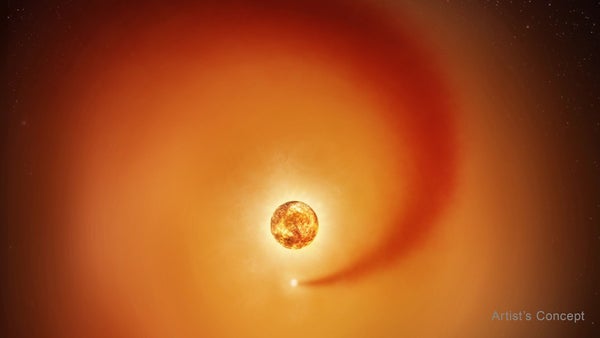
Astronomers may have finally solved one of the weirdest mysteries of our night sky: why Betelgeuse, a massive star in the constellation Orion, seems to fade and brighten as if it were operated by a heavenly dimmer switch.
Using the Hubble Space Telescope and ground-based observatories, scientists observed Betelgeuse for almost eight years and found that patterns in the star’s light suggested the wake of another, unseen star was passing through its atmosphere.
“It’s a bit like a boat moving through water. The companion star creates a ripple effect in Betelgeuse’s atmosphere that we can actually see in the data,” said Andrea Dupree, an astronomer at the Center for Astrophysics | Harvard & Smithsonian and lead author of a preprint paper about the finding that will be published in the Astrophysical Journal, in a statement.
On supporting science journalism
If you're enjoying this article, consider supporting our award-winning journalism by subscribing. By purchasing a subscription you are helping to ensure the future of impactful stories about the discoveries and ideas shaping our world today.
The other star appears to pass in front of Betelgeuse every six years or so. If the findings are confirmed by follow-up observations, they will help explain why Betelgeuse, a bright, nearby star that could fit 400 million suns inside it, periodically seems to be on the point of vanishing before our eyes. That’s what happened in 2020: at that time, Betelgeuse appeared so faint that it fed rumors that it was possibly about to explode into a supernova. (Astronomers, in general, did not think that such a cataclysm was imminent. But they were mightily confused.)
Scientists had predicted the existence of a companion star, dubbed Siwarha, before. But the evidence was lacking, Dupree said in the recent statement.
“With this new direct evidence, Betelgeuse gives us a front-row seat to watch how a giant star changes over time,” she said. “Finding the wake from its companion means we can now understand how stars like this evolve, shed material, and eventually explode as supernovae.”
The research was presented on Monday at the annual meeting of the American Astronomical Society.