
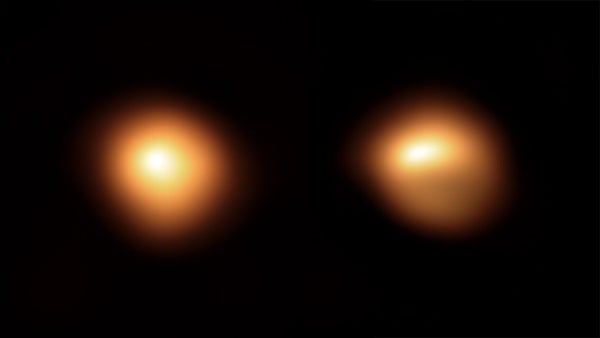
After a mysterious four-month fading streak, the star known as Betelgeuse could be on its way to regaining its shine.
Easily recognizable as the right ‘shoulder’ in the constellation Orion, Betelgeuse is normally one of the ten brightest stars in the night sky. But it began getting dimmer in October last year, and by mid-February it had lost more than two-thirds of its brilliance — a difference noticeable to the naked eye. But the star has now brightened by around 10% from its dimmest point, says Edward Guinan, an astrophysicist at Villanova University outside Philadelphia, Pennsylvania, whose team has been tracking it for 25 years.
“For now, it looks like it’s bottoming out,” says Andrea Dupree, an astronomer at the Harvard–Smithsonian Center for Astrophysics in Cambridge, Massachusetts. “But who knows, maybe it will cough and go back down again.” A group of amateur and professional astronomers called the American Association of Variable Star Observers, also based in Cambridge, has also documented the upswing.
On supporting science journalism
If you're enjoying this article, consider supporting our award-winning journalism by subscribing. By purchasing a subscription you are helping to ensure the future of impactful stories about the discoveries and ideas shaping our world today.
The reasons for the dimming remain a puzzle, Dupree says. Astronomers have proposed several explanations, but none is sufficient to explain all the observations, she adds.
Friendly giant
Betelgeuse is a favourite of stargazers worldwide. At a relatively close 220 parsecs (700 light years) from the Sun, the red supergiant — a large but relatively cool-burning type of star — has also been a boon for astronomers. Although its mass is just a dozen times that of the Sun, its dimensions are gigantic: if Betelgeuse were in the centre of the Solar System, it might engulf all the planets up to Jupiter.
As a consequence, it is one of the few stars that can be imaged in detail from Earth, as opposed to appearing as a single, unresolved dot of light. Since the 1990s, Dupree and others have been able to reveal features on its surface called convection cells — blobs of hot plasma that seethe up to the surface before cooling and falling back down. These are enormous: whereas convection cells on the Sun are roughly the size of France, those on Betelgeuse “are the size of from here to Mars”, Dupree says.
Because it is so bright, the star can overwhelm many state-of-the-art astronomical instruments, and observing it requires special measures. In ground-based infrared observations made this year, for example, Dupree and her collaborators had to use the telescope in ‘slew mode’ — quickly panning across the sky so that no spot on the camera sensor would be exposed to Betelgeuse’s light for too long.
But the star’s brightness is not a problem for Guinan. For decades, his team has been measuring it with a 25-centimetre amateur telescope set up in his colleague Richard Wasatonic’s garden in Allentown, Pennsylvania. The easy access has its perks for Wasatonic, Guinan says. “We take data every clear night, usually two nights a week. Whenever the sky clears, he just runs outside in his pyjamas.”
Broken routine
Guinan’s team has documented a roughly 425-day cycle of dimming in the star, but normally the brightness would vary by no more than 25%. Last year, Guinan says, he considered shutting down the programme because the team was “getting tired” of the star, but ultimately decided against it. “I told Richard, if we stop, it will do something,” he says.
Then, in October, Betelgeuse began to dim, and by December the fading had become so dramatic that Guinan decided to send out an online alert called an astronomer’s telegram. Many others rushed to observe the star.
One leading explanation for the dimming is the emergence of a large, unusually cool convection cell. Another is that the star could be moving behind a dust cloud. But Dupree says that the observations made so far seem mutually inconsistent. “The ultraviolet behaviour is different from the optical, which behaves differently from the infrared.”
Some have speculated that the star’s erratic swings in brightness mean it might be approaching the end of its life. Betelegeuse is estimated to be less than 10 million years old, but astrophysicists predict that it will end in a supernova explosion sometime in the next 100,000 years. When it does, it will be a spectacular sight — for weeks, it will be brighter than the full Moon and visible during the day. But what happens right before a star explodes in this way is unknown, and astronomers say the exact timing of the fiery end is impossible to predict. Still, says Guinan, “I’m cheering for it to blow up.”
This article is reproduced with permission and was first published on February 26 2020.