
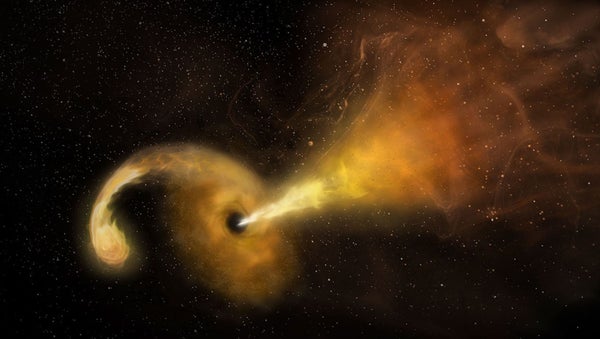
If starry galaxies are like bright ships on a cosmic sea, then supermassive black holes are like their dark anchors. Weighing millions to billions of suns apiece, these shadowy behemoths typically sit at the centers of large galaxies, where they shape their surroundings with their immense gravitational pull. But what happens when one somehow gets unmoored and drifts away?
Astronomers have struggled to answer this question because these nomadic black holes are practically invisible in the outskirts of galaxies. They emit no light as they move through mostly empty space—unless, that is, they get a craving for a rare stellar snack passing by.
In a new study, astrophysicists report the best-yet example of a supermassive black hole far from its galactic center. It was spotted via an ultrabright outburst from a dying star. If a star gets too close to a black hole, it will be shredded by tidal forces in what’s called a tidal disruption event (TDE). In November 2025 the team happened to catch one such event as it occurred: the researchers watched as a TDE briefly flared brighter than 10 billion suns at the fringes of a massive galaxy located some 750 million light-years away in the constellation of Cetus. Published in Astrophysical Journal Letters, the result reveals the presence of a million-solar-mass black hole.
On supporting science journalism
If you're enjoying this article, consider supporting our award-winning journalism by subscribing. By purchasing a subscription you are helping to ensure the future of impactful stories about the discoveries and ideas shaping our world today.
“If you’d looked, you never would have guessed there was a supermassive black hole hiding there, and it’s only because it happened to eat the star that we were able to figure out where it was,” says Robert Stein, lead author of the study and an astrophysicist at the University of Maryland and NASA’s Goddard Space Flight Center.
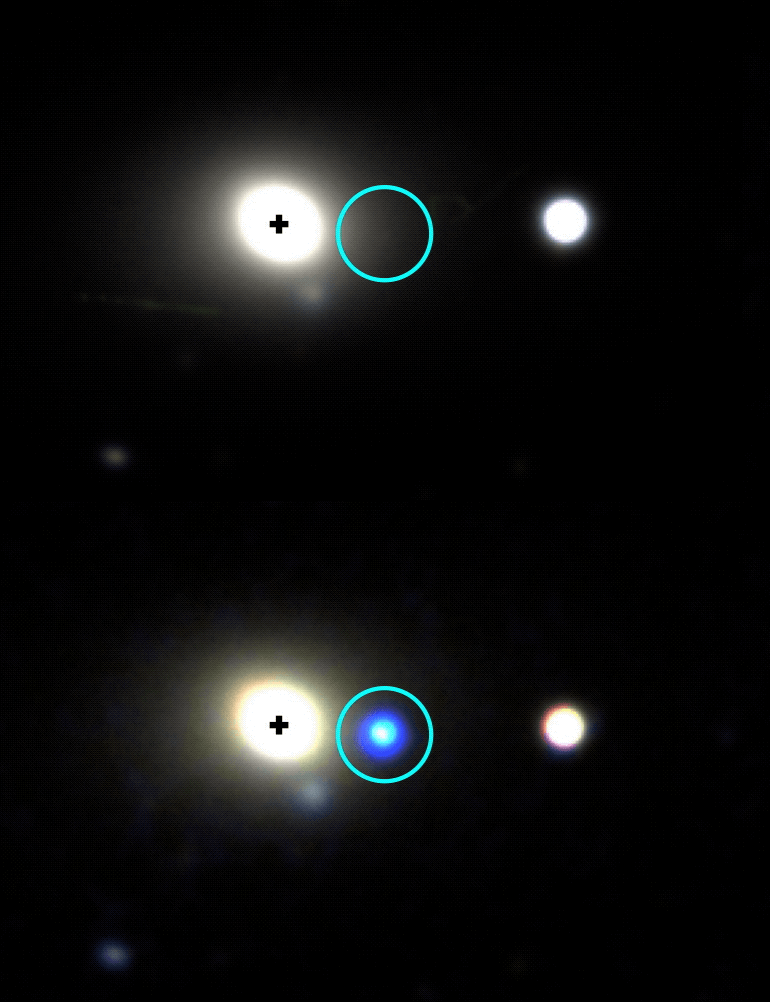
The bright flash of an eaten star in a tidal disruption event alerted scientists to the black hole's presence.
NASA
This isn’t the first TDE linked to an off-center black hole: in 2024 other researchers found one some 2,600 light-years from another galaxy’s core. But this latest example, called TDE 2025abcr, is more than 30,000 light-years from the center of the galaxy WISEA J014656.04-152214.7, making its progenitor black hole arguably the farthest-flung that scientists have ever seen. (In 2023 another team found what could be a supermassive nomad trailing a 200,000-light-year-long streak of stars in its wake, but that object lacks a smoking-gun TDE and may instead be a very weird galaxy.)
Stein and his colleagues noticed the black hole in data from the Zwicky Transient Facility (ZTF), a survey conducted at the Palomar Observatory in southern California that continually scans the night sky. ZTF detects about half a million significant celestial flashes each night, however, so pinpointing a TDE required a machine-learning model trained to find candidates in the data deluge. When the model flagged this candidate, Stein says, its identity was already “unambiguous” despite its anomalous location.
Subsequent studies with other facilities, such as the Southern Astrophysical Research (SOAR) telescope in Chile and NASA’s space-based Neil Gehrels Swift Observatory clinched the discovery—and just in time, too: after the initial detection, Stein’s team only had a couple of months to scrutinize the rapidly fading TDE before its patch of sky passed back into invisibility behind our sun.
Using all-too-brief TDEs to spot wandering black holes can make in-depth follow-up research difficult, according to Pieter van Dokkum, an astrophysicist at Yale University. Even so, he says, the fortuitous follow-ups by Stein and his collaborators make this event “the best candidate so far” for a giant black hole at a galaxy’s edge. Van Dokkum was not involved in the study but did lead the 2023 team that found the potential runaway with a tail of stars.
“It’s hard to study what happens long-term because you only have one shot at it—you have this TDE, and then you interpret it, and then it’s gone. But these authors in particular have put in a lot of effort to get as much information as they could while the event was still happening,” he says.
The natural next step, he adds, would be to discover “not one but a sample of these things—because then you can do statistical studies.”
Astronomers are on the cusp of doing just that, mostly thanks to the new Vera C. Rubin Observatory, a sort of supercharged ZTF that has just begun a much wider and deeper survey of the sky. Soon the field may have dozens or hundreds of nomadic black holes to examine.
The key question is how, exactly, these wandering giants got so far from their galactic centers. It’s possible that when two galaxies merge, most of the smaller galaxy’s stars are stripped away until its black hole lurks, naked and alone, at the larger galaxy’s edges, slowly falling closer to the core of its new home.
It’s also possible that they’re the result of multigalaxy mergers. When two galaxies merge, their black holes typically form a binary pair, orbiting each other at the center of the single postmerger galaxy. But three’s a crowd: if a third galaxy also merges with the newly formed one, that additional black hole can get kicked out by the existing pair and hurtle toward the edge.
This means Stein’s newfound wanderer could be coming or going, either on its way out of or heading into the heart of its galaxy.
Astrophysicists predict that, throughout cosmic history, many galaxies have merged and formed, sprinkling scarcely seen outcasts across the universe. Finding more of them should provide important clues about just what that history looks like, says Tousif Islam, a theorist at the University of California, Santa Barbara’s Kavli Institute for Theoretical Physics. Islam was not involved with the new study but has studied the physics of black-hole binary ejections.
“Understanding where this supermassive black hole came from is quite interesting,” Islam says. “If you keep seeing this kind of event 10 times, 20 times, then you can try to build a statistical understanding of the universe.”