
A remarkable dance occurs between the flowers of avocado trees every spring: the trees change sex daily, moving from female to male or male to female, then back before the next morning. Botanist A. B. Stout observed this reproductive strategy as early as 1927, but researchers couldn’t explain how it worked until now.
All avocado trees (Persea americana) are cosexual, or hermaphrodites, meaning they contain both sexes in one plant. A-type trees begin with flowers in the female phase (receptive to pollen) in the morning and change to the male phase (producing pollen) in the afternoon of the next day. B-type trees operate on different timing, making them male in the morning and female in the afternoon. For a new study in the Proceedings of the National Academy of Sciences USA, Jeffrey S. Groh, a postdoctoral researcher at the University of California, Berkeley, and his colleagues pinpointed a single protein-coding gene that lets A- and B-type trees inherit the sex-swapping behavior. The protein it produces activates a host of additional genes to coordinate flowers opening and closing in rhythm to aid the trees’ reproductive strategy, letting “the whole tree [pulse] female to male or male to female,” he says.

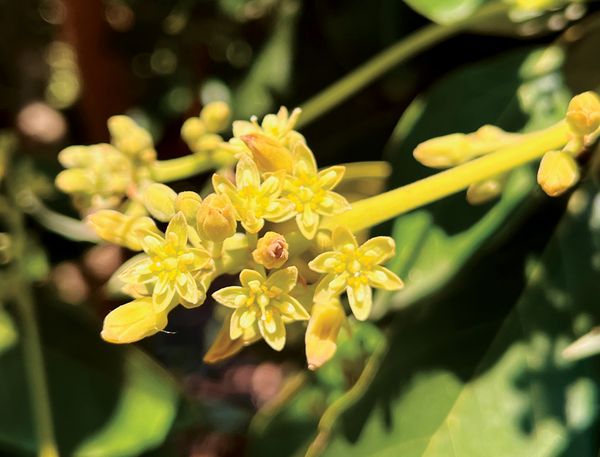
Avocado flowers in male and female phases. Flowers at left are recently opened male-phase flowers about to shed pollen. Flowers at right are female flowers just beginning to close.
Jeffrey Scott Groh
On supporting science journalism
If you're enjoying this article, consider supporting our award-winning journalism by subscribing. By purchasing a subscription you are helping to ensure the future of impactful stories about the discoveries and ideas shaping our world today.
Cathy Rushworth, a plant evolutionary geneticist at Utah State University, who was not involved in the study, says the gene region in question shows a very clear signal in this work—almost like it can “glow in the dark.” Tools to reveal this level of detailed genetic information, she adds, have only recently become available and inexpensive enough to see wider use.
Flowering plants, called angiosperms, employ an immense diversity of reproductive strategies. And although the strategy used by avocados is found in a few other species in the same family, the researchers determined that it was not driven by the same mechanism in, for instance, the distantly related true cinnamon. This, they say, indicates that it most likely evolved separately multiple times. The genetic evidence suggests avocados’ ancestors picked the habit up about 40 million years ago.
“Through the power of genetics,” Groh says, “we can detect traces of this rhythm far into the ancient past, a humbling reminder that our own experience of this beautiful phenomenon is just a tiny sliver of its evolutionary history.”