
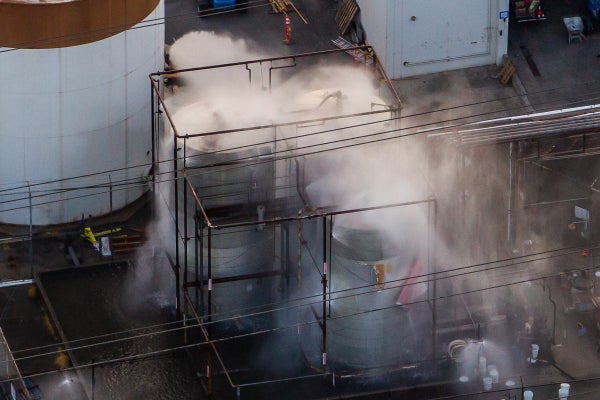
As more than 50,000 residents of Garden Grove, Calif., returned home on Tuesday and Wednesday after a narrowly averted chemical crisis at an aerospace plant, a rupture at a separate chemical tank in Washington State claimed two lives and left nine people missing and presumed dead.
The back-to-back incidents are among several high-profile disasters at chemical plants in the past year. And a Trump administration proposal to roll back federal regulations that are meant to guard against such accidents means they could become more frequent, threatening surrounding communities and on-site workers.
Last year, the Environmental Protection Agency proposed repealing a 2024 rule that tightened safeguards that were designed to prevent explosions and the release of toxic chemicals at chemical plants and refineries. The rollback, which is opposed by California’s attorney general, would reduce requirements for facilities to implement safer technologies, involve employees in safety planning and conduct third-party audits after an accident. The plan would also erase a mandate that facilities consider climate-related disasters such as floods when making emergency plans.
On supporting science journalism
If you're enjoying this article, consider supporting our award-winning journalism by subscribing. By purchasing a subscription you are helping to ensure the future of impactful stories about the discoveries and ideas shaping our world today.
Without the rule, many of these details would be left to the discretion of individual companies and their safety culture. And that, experts say, means that accidents will keep happening.
“There is just not enough of that kind of planning that goes on,” says Philip Price, a retired senior research scientist and chemist in Maryland, who has worked on chemical incident investigations.
The rule hasn’t been repealed yet; a call for public comment on the proposal to repeal it just closed. The rule itself hasn’t yet been fully implemented, however, says Emma Cheuse, an attorney for the environmental law nonprofit Earthjustice, which opposes the rollback.
“Some of the key provisions in the rule have compliance deadlines that were going to kick in in May 2027, so EPA is proposing to undo and weaken provisions in advance of those requirements,” Cheuse says.
The Trump administration has argued that the 2024 stipulations that require disclosures about hazardous chemicals have made chemical facilities more vulnerable to attacks and that the rule has been costly and burdensome for businesses.
The twin crises in the past week have sparked questions over safety rules for chemical plants and processing facilities. The one in southern California began at the GKN Aerospace Transparency Systems plant on May 22, when temperatures spiked inside a tank containing around 7,000 gallons of methyl methacrylate, raising the risk that the liquid, which is used in making plexiglass, would volatilize into a gas and cause a massive explosion. In a press conference on May 25, Orange County Fire Authority officials said that a valve in the tank’s cooling system failed, leading to the potential explosion. Methyl methacrylate can cause damage to the skin and respiratory system. Andrew Whelton, an engineering professor at Purdue University, who has developed monitoring and response plans after chemical accidents, explains that because of the chemical’s nature, some people who are exposed to even small amounts will develop serious allergic reactions.
The other incident, in Washington State, involved a tank containing 900,000 gallons of a hazardous chemical called white liquor that ruptured at a paper mill on May 26. Used to make pulp, white liquor is strongly alkaline, or basic, and causes serious burns if touched. Nine people are missing, one person is dead, and eight employees and one firefighter were injured. As of Wednesday, emergency responders were continuing to search for those missing. The cause of the rupture is not yet known.
According to the EPA, about 12,000 facilities around the country are covered by the 2024 risk management plan rule. Risk management plans force plant managers to think about what could go wrong and to coordinate with local emergency officials so that firefighters and other emergency personnel know what to expect, should they be called to a plant for an accident, Price says. It’s not clear whether such a plan was in place in southern California, he says, but several common safety measures, such as a permanent barrier around the tank that would contain any spills, did not appear to be present. (GKN did not respond to questions about this barrier and the incident by the time of publication.)
In 2025 GKN Aerospace agreed to pay more than $900,000 for violations uncovered by the South Coast Air Quality Management District. The Occupational Health and Safety Administration also cited the Garden Grove site in 2018 for a failure to inspect and maintain machinery as recommended.
“California leads the nation in tracking and controlling hazardous chemicals, and CalEPA [the California Environmental Protection Agency] works with local fire and health agencies so regulators and first responders know which facilities handle dangerous materials,” says Kate Folmar, a spokesperson for CalEPA. “Guided by strong environmental justice laws, we use every oversight and enforcement tool available to reduce risk and strengthen protections for the communities that have borne the greatest burdens.”
Some 215 chemical incidents received media coverage in 2025 alone, according to the Coalition to Prevent Chemical Disasters’ Chemical Incident Tracker. These included an explosion at a manufacturing facility in McEwen, Tenn., that killed 16 people. The federal Chemical Safety and Hazard Investigations Board is also currently investigating two 2026 hydrogen sulfide releases, one in West Virginia and one in Maine, each of which killed two workers.
“Unfortunately, it looks like incidents continue to happen at facilities directly covered by the rule and facilities that EPA is not current regulating,” Cheuse says, “so all of that just shows the need to move forward on safety and protect communities and children from toxic chemical exposure instead of backsliding.”