Pitch Interactive and Amanda Montañez; Source: Research by Amanda Hobbs; Expert review by Amy Wisniewski University of Oklahoma Health Sciences Center
Join Our Community of Science Lovers!
On supporting science journalism
If you're enjoying this article, consider supporting our award-winning journalism by subscribing. By purchasing a subscription you are helping to ensure the future of impactful stories about the discoveries and ideas shaping our world today.
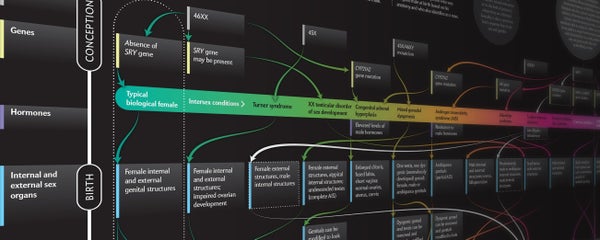
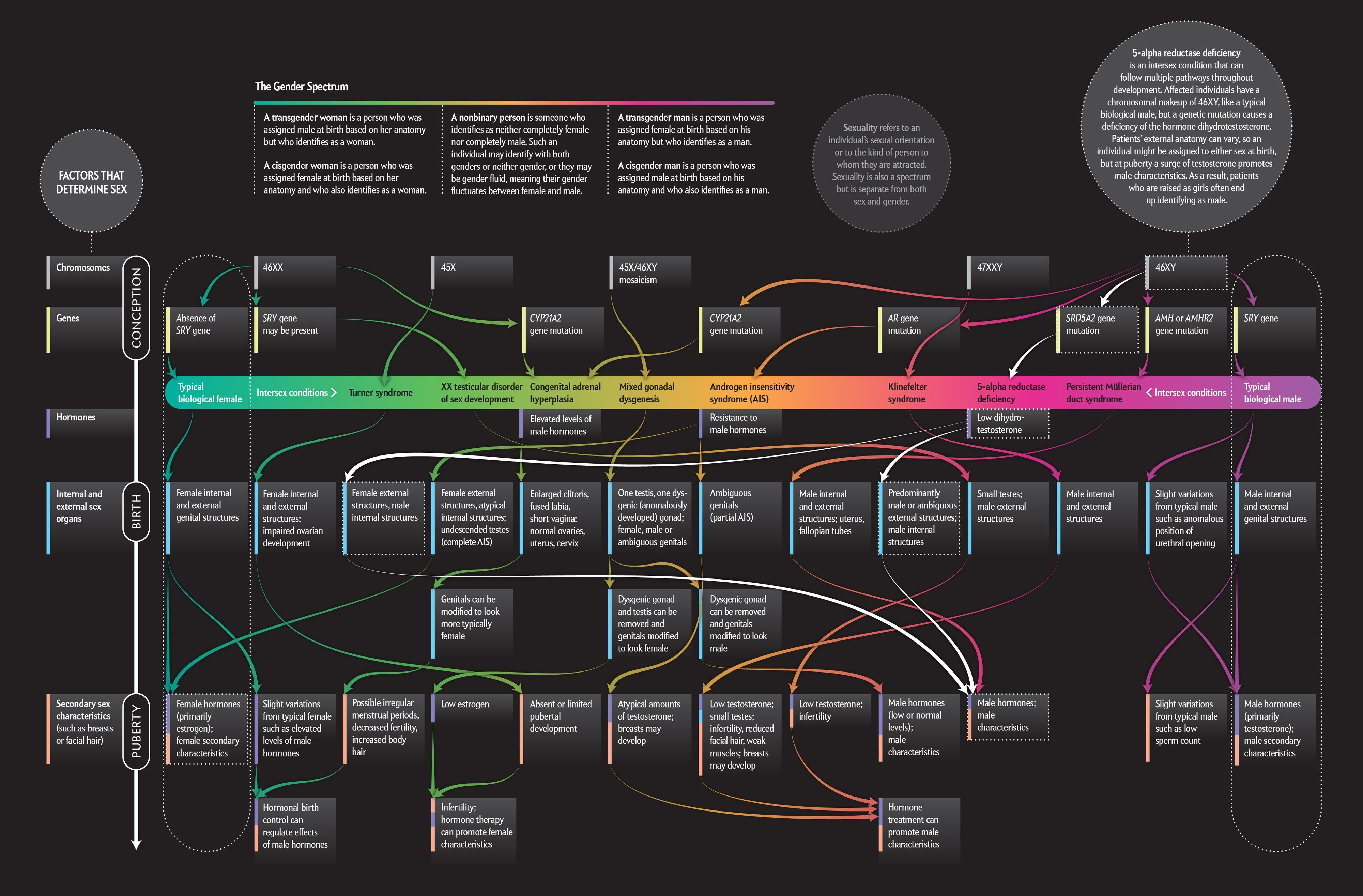
Humans are socially conditioned to view sex and gender as binary attributes. From the moment we are born—or even before—we are definitively labeled “boy” or “girl.” Yet science points to a much more ambiguous reality. Determination of biological sex is staggeringly complex, involving not only anatomy but an intricate choreography of genetic and chemical factors that unfolds over time. Intersex individuals—those for whom sexual development follows an atypical trajectory—are characterized by a diverse range of conditions, such as 5-alpha reductase deficiency (highlighted in graphic below). A small cross section of these conditions and the pathways they follow is shown here. In an additional layer of complexity, the gender with which a person identifies does not always align with the sex they* are assigned at birth, and they may not be wholly male or female. The more we learn about sex and gender, the more these attributes appear to exist on a spectrum.
*The English language has long struggled with the lack of a widely recognized nongendered third-person singular pronoun. A singular form of “they” has grown in widespread acceptance, and many people who do not identify with a binary gender use it.
Credit: Pitch Interactive and Amanda Montañez; Source: Research by Amanda Hobbs; Expert review by Amy Wisniewski University of Oklahoma Health Sciences Center
Subscribe to Support Independent Journalism
Great science journalism requires human expertise, time, effort and creativity. And it costs money. That’s why I and the journalists here at Scientific American hope you’ll join our community.
When you subscribe, you are supporting staff and freelance journalists who are passionate about telling science stories that are true, important and compelling. Our editors and reporters are often experts in their fields, which means they understand the nuances of big discoveries and can untangle the breakthroughs from the hype. With a subscription, you are also supporting rigorous fact-checking to ensure the words we publish are precise and accurate. And you’re supporting original illustrations, graphics and photos that bring you closer to an advanced laboratory, an ice sheet in Antarctica or a space mission in orbit. You’re helping us craft other types of high-quality journalism as well: Our newsletters are carefully written, edited and curated by staffers you have or will come to know and love. Our Science Quickly podcast is based on original reporting, collaboration with editors and scientists and exacting production.
Subscriptions keep this engine running so we can continue to deliver thoughtful, rigorous and independent science journalism to you. In an era of viral misinformation, this work is crucial. If you value what we do, I hope you’ll consider joining us as a subscriber
Thank you,
Jeanna Bryner, Editor in Chief, Scientific American