New Issue: Orbital Catastrophe Ahead? Read Now

Black Hole Caught Blasting Matter into Space at 130 Million MPH

X-ray space telescopes caught a supermassive black hole flinging matter into space at a fifth of the speed of light

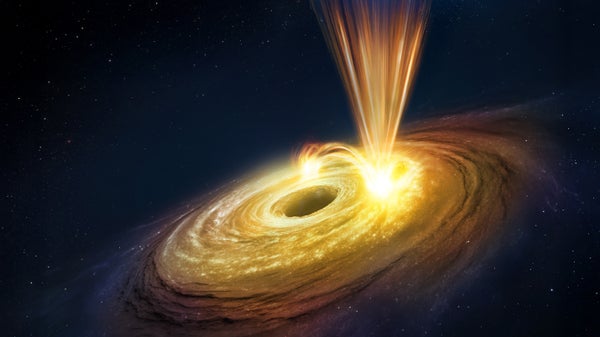
An illustration of the black hole within NGC 3783 shows a swirling “doughnut” of golden material known as an accretion disk: a ring of material that is circling the black hole and that will ultimately be devoured, pulled in closer and closer by the black hole’s colossal gravity

An illustration shows the black hole within the galaxy NGC 3783 as it erupts.

ESA

Join Our Community of Science Lovers!

Supermassive black holes are the monsters of the universe, so it is perhaps only fitting that astronomers discovered one of these behemoths unleashing a bright x-ray flare that one of the researchers, astronomer Matteo Guainazzi, described as “almost too big to imagine” in a European Space Agency (ESA) press release.

Within hours of erupting, the blast faded, and the black hole began to whip up winds more powerful than anything we can imagine on Earth and flinging material into space at about 130 million miles per hour—a fifth of the speed of light. For comparison, plasma ejected during a coronal mass ejection from the sun typically travels at a mere three million mph.

To study the black hole, astronomers used two x-ray space telescopes: the ESA’s XMM-Newton and the X-Ray Imaging and Spectroscopy Mission, which is a collaboration between the ESA, NASA and the Japan Aerospace Exploration Agency. Lurking at the center of the spiral galaxy NGC 3783, the supermassive black hole—with a mass of 30 million suns—powers the galaxy’s heart, a region known as an active galactic nucleus.


On supporting science journalism

If you're enjoying this article, consider supporting our award-winning journalism by subscribing. By purchasing a subscription you are helping to ensure the future of impactful stories about the discoveries and ideas shaping our world today.


According to Guainazzi’s statement, tangled magnetic fields in this region may have suddenly “untwisted,” generating the winds. Knowing more about active galactic nuclei, and the way that they generate such powerful jets and winds, is key to understanding how galaxies form and evolve over time, study co-author and ESA researcher fellow Camille Diez said in the press release.

The research was published on Tuesday in Astronomy & Astrophysics.

Editor’s Note (12/9/25): This article was edited after posting to better clarify the speed at which the black hole flung material into space and the source of Matteo Guainazzi’s and Camille Diez’s comments.

Subscribe to Support Independent Journalism

Great science journalism requires human expertise, time, effort and creativity. And it costs money. That’s why I and the journalists here at Scientific American hope you’ll join our community.

When you subscribe, you are supporting staff and freelance journalists who are passionate about telling science stories that are true, important and compelling. Our editors and reporters are often experts in their fields, which means they understand the nuances of big discoveries and can untangle the breakthroughs from the hype. With a subscription, you are also supporting rigorous fact-checking to ensure the words we publish are precise and accurate. And you’re supporting original illustrations, graphics and photos that bring you closer to an advanced laboratory, an ice sheet in Antarctica or a space mission in orbit. You’re helping us craft other types of high-quality journalism as well: Our newsletters are carefully written, edited and curated by staffers you have or will come to know and love. Our Science Quickly podcast is based on original reporting, collaboration with editors and scientists and exacting production.

Subscriptions keep this engine running so we can continue to deliver thoughtful, rigorous and independent science journalism to you. In an era of viral misinformation, this work is crucial. If you value what we do, I hope you’ll consider joining us as a subscriber

Thank you,

Jeanna Bryner, Editor in Chief, Scientific American

Subscribe